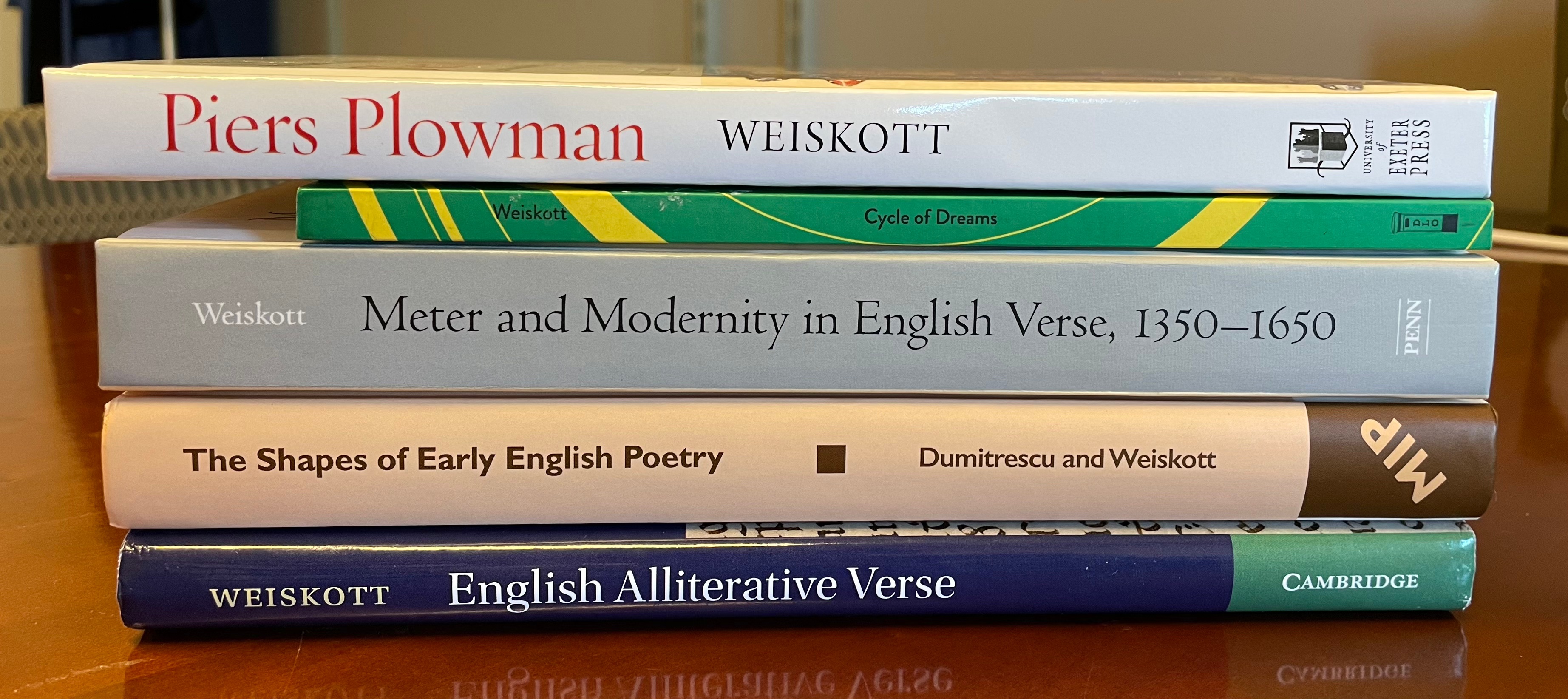
My research focuses on meter and poetics (what makes poetry tick). I am especially interested in poetry from the medieval period, which has led to an interest in periodization itself. The greater part of my scholarship addresses the historicity of early English literature: its forms and cultural meanings, and how those are mediated by modern disciplinary study. My scholarly method bridges ‘formalism’ and ‘historicism.’ I am interested in the social implications of literature, the phenomenology of poetry reading, and how we come to know what we think we know about the past. These interests converge on William Langland’s Piers Plowman, an enigmatic long alliterative poem of the fourteenth century. More recently, I have been publishing on contemporary avant-garde American poetry, an undertaking that has prompted new questions about the historicity and limitations of prevailing modes of literary reading.
My first two monographs rearticulated English literary history through the cultural lives of metrical traditions, a new approach I call “verse history.” One reviewer praised the methodologies of my second monograph, Meter and Modernity in English Verse, 1350-1650, as “artisanal philology.”
My annotated student edition of the A-text of Langland’s Piers Plowman, reedited from the manuscripts, is published by University of Exeter Press (2025). My edition is modeled on Derek Pearsall’s Exeter edition of the C-text. I have also edited Geoffrey Chaucer’s Book of the Duchess, for the forthcoming Cambridge Chaucer project. A student edition of the alliterative dream vision Death and Life along with the shorter Middle English alliterative poems, of which fifteen survive, is in preparation for Medieval Institute Publications.
My third monograph, Unheard Melodies: Apophatic Poetics and Literary Reading (Fordham University Press, forthcoming), brings my interests in phenomenological poetics to the full gamut of English literature, from Beowulf to Claudia Rankine, and to the music of Bob Dylan, with emphasis on the fourteenth and twenty-first centuries and on questions of methodology. Pivoting historically around John Keats’s translation of Christian theological apophaticism into lyric poetry, Unheard Melodies concerns the paradoxical power of literature to represent what literature cannot represent: novels no one can read, lyrics no one can hear, syllables no one can pronounce, spaces no one can inhabit, experiences no one can have, and more. While poetry is the focus, one chapter considers Vladimir Nabokov’s novels-within-novels. Methodological keywords are lyric, meter, literary reading, and career.
Separate series of notes and articles reconsider the Latin poetry of John Gower; the place of fourteenth-century poets in the consolidation of the field of English literary history over the course of the seventeenth, eighteenth, and early nineteenth centuries; and the Ricardian poets’ use of grammar-school texts.
I obtained my BA in English and Classical Civilization from Wesleyan University. My MA and PhD in English Language and Literature, and an MPhil in Medieval Studies, are from Yale University.


monographs
Unheard Melodies: Apophatic Poetics and Literary Reading. Fordham University Press, forthcoming.
Meter and Modernity in English Verse, 1350-1650. Philadelphia: University of Pennsylvania Press, 2021. [JSTOR]
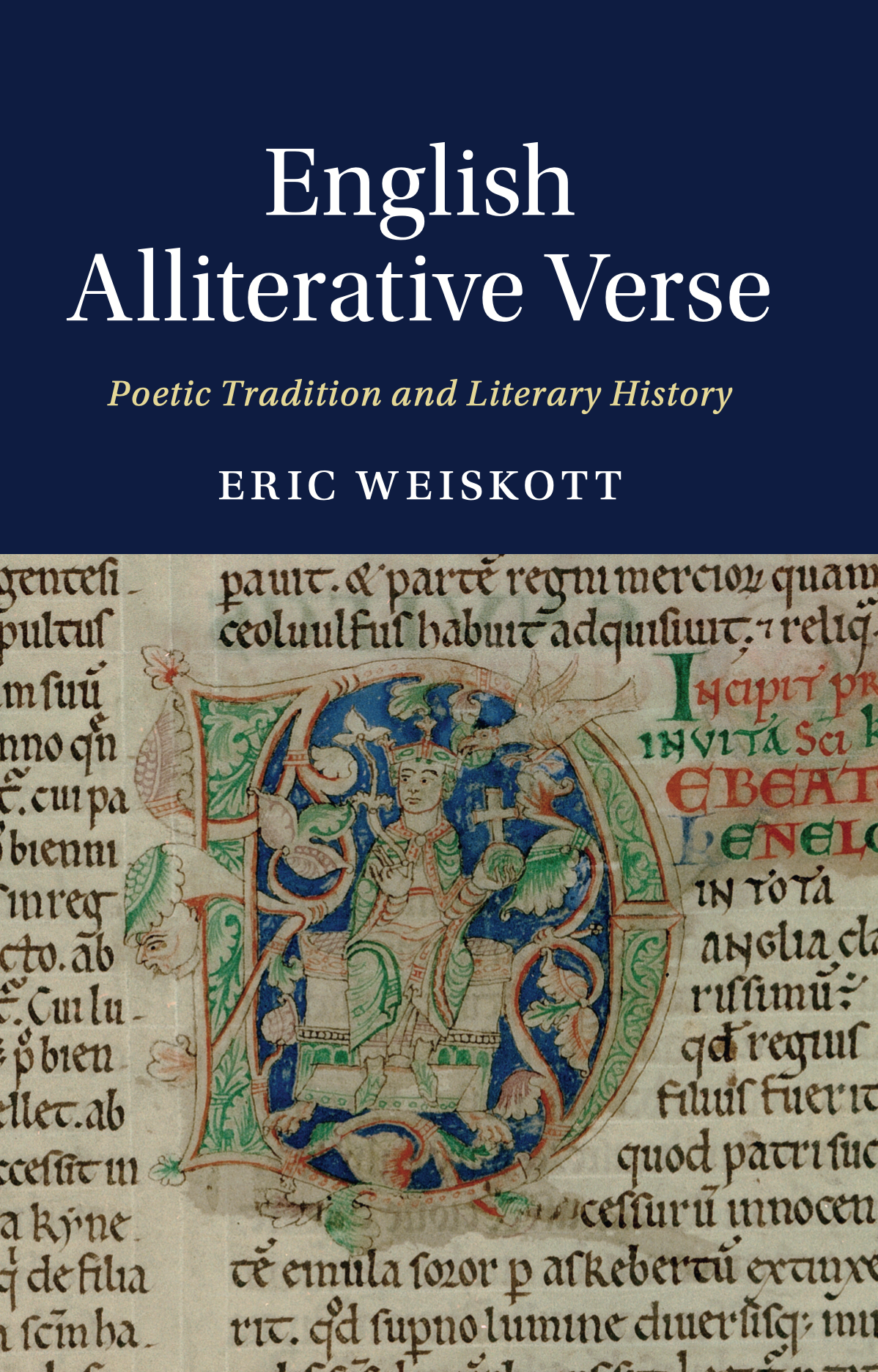
English Alliterative Verse: Poetic Tradition and Literary History. Cambridge: Cambridge University Press, 2016. Paperback 2019. [Cambridge Core]
scholarly editions
“Death and Life” and the Shorter Alliterative Poems. Invited and in preparation for Medieval Institute Publications.
with the assistance of Celia Smithmier, “The Death of Blanche the Duchess.” In The Works of Geoffrey Chaucer, ed. Julia Boffey and A. S. G. Edwards (Cambridge University Press, under contract).
William Langland, Piers Plowman: A New Annotated Edition of the A-text. Exeter: University of Exeter Press, 2025. [academia.edu]
edited collections
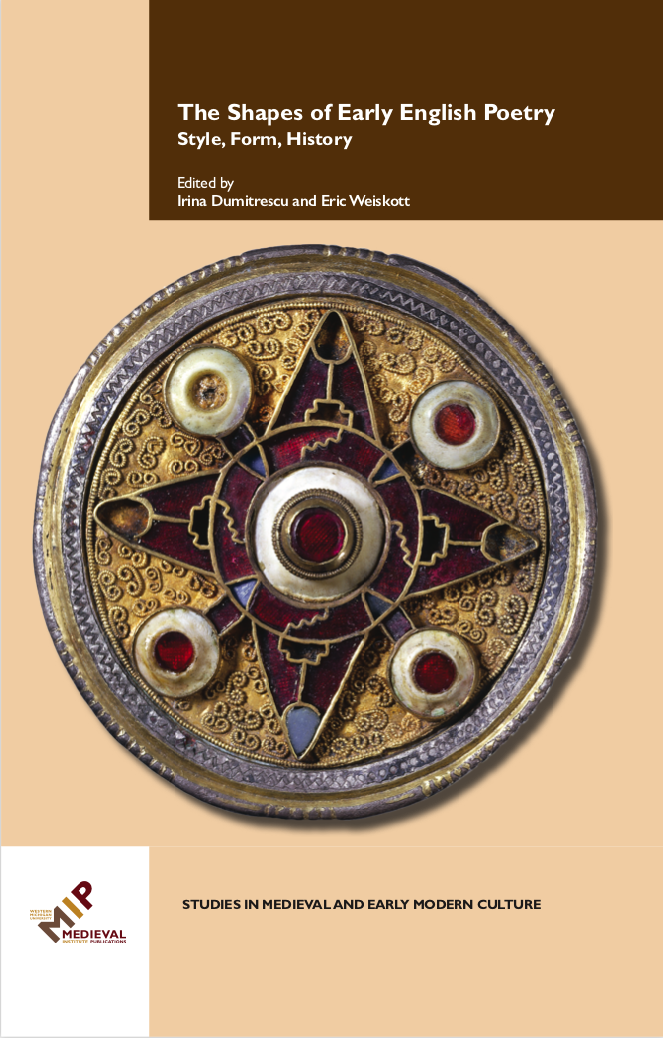
with Irina Dumitrescu, The Shapes of Early English Poetry: Style, Form, History. Kalamazoo, MI: Medieval Institute, 2019. In honor of Roberta Frank.
with Stephanie L. Batkie, “Chaucer’s Langland.” Yearbook of Langland Studies 32 (2018): 237-389. An essay cluster.
articles
“Bob Dylan’s ‘ultimately inapprehensible’ Career: ‘Murder Most Foul’ and the Loss of History.” Studies in Popular Culture (forthcoming).
with Joe Stadolnik, “A Middle English Poem in the Reynard Tradition.” Modern Philology (forthcoming).
“Periodization and Disciplinarity: On ‘Medieval Studies’.” Speculum (forthcoming).
with Gina Case, “A Re-edition and Reading of a Middle English Alliterative Prophecy.” Studies in Philology (forthcoming).
“Problems in Beat Prosody: The Middle English Alliterative A-verse.” Studies in Philology 123 (2026).
“Before Chaucer, Inc.: Thomas Pope Blount’s Literary History.” Chaucer Review 61 (2026): 22-40.
“The Carmen super multiplici viciorum pestilencia, the Epistola to Archbishop Arundel, and John Gower’s Process of Revision.” Journal of Medieval Latin 36 (2026): 177-96.
“The Grammar-School auctores, Latin Verse Form, and Ricardian Poetry.” New Medieval Literatures 26 (2026): 35-68.
“The Authenticity of the Rubrics in the A-text of Piers Plowman.” Medium Ævum 94 (2025): 345-62.
“Avant-Garde Difficulty and the Shape of Claudia Rankine’s Poetic Career.” Critical Quarterly 67.1 (2025): 72-100. [academia.edu]
“‘Coins of a former age’: Thomas Tyrwhitt’s ‘Essay on the Language and Versification of Chaucer’ (1775) and English Historical Metrics.” Modern Philology 123 (2025): 87-102.
“John Weever’s Copies of Langland, Gower, and Chaucer.” Mediaevalia 46 (2025): 298-322.
“New Poetics” [review of Rebecca M. Rush, The Fetters of Rhyme: Liberty and Poetic Form in Early Modern England (Princeton: Princeton University Press, 2021); Matthew Kilbane, The Lyre Book: Modern Poetic Media (Baltimore: Johns Hopkins University Press, 2024); Naomi Levine, The Burden of Rhyme: Victorian Poetry, Formalism, and the Feeling of Literary History (Chicago: University of Chicago Press, 2024); and Peter Miller, Poetry, Sound, and the Matter of Prosody, 1800–2000 (Oxford: Oxford University Press, 2025)]. Exemplaria 37 (2025): 290–307.
“William Langland and Maximianus on Impotence.” Neuphilologische Mitteilungen 126.2 (2025): 93-105.
“Thomas Percy’s ‘Essay on the Metre of Pierce Plowman’s Visions’ (1765) and the Idea of an Alliterative Tradition.” Modern Language Review 120 (2025): 469–83.
“Enigma, Audience, Locale: The Ruin as a Riddle.” Journal of English and Germanic Philology 123 (2024): 137-56. [academia.edu]
“‘I’m on the dark side of the road’: Bob Dylan, William Langland, and Being Already Gone.” postmedieval 15 (2024): 329-46. [academia.edu]
“Middle English fobbere and the Critical Editing of Piers Plowman.” English Studies 105 (2024): 529-35. [academia.edu]
“Poetry and the Inapprehensible: A Genealogy.” ELH 91 (2024): 629-62. [academia.edu]
“Real Magic in Sir Gawain and the Green Knight.” Essays in Criticism 74 (2024): 422-48. [academia.edu]
“Ricardian Poetry in Florence Converse’s Long Will (1903).” Notes and Queries 71 (2024): 287-95.
“Thomas Campbell and the Unmaking of John Gower.” Leeds Medieval Studies 4 (2024): 19-28.
“William Langland, ‘Father of English Poetry’: Thomas Dunham Whitaker’s Piers Plowman.” Papers of the Bibliographical Society of America 118 (2024): 559-91. [academia.edu]
“The Alliterative Conflict of Wit and Will: Toward a Reappraisal.” The Mediaeval Journal 13.1 ([2026 for] 2023): 103-16.
“The Elusive Transformation of Alliterative Meter.” Chaucer Review 58 (2023): 208–31. [academia.edu]
“‘Loquela gravis iuvat’: Gower’s O deus immense and the Place of Poetry, 1398-1400.” Studies in the Age of Chaucer 45 (2023): 205-46. [academia.edu]
“Lost Sheep: Metaphor and Simony in John Gower’s Latin Poetry.” Studia Neophilologica 95 (2023): 307-17. [academia.edu]
“Cumulative Revision in John Gower’s Quicquid homo scribat.” English Studies 103 (2022): 547-54. [academia.edu]
“Gower’s Quatrains: Language, Rhyme, Occasion.” English Studies 103 (2022): 777-86. [academia.edu]
“The Meter of the Ophni and Phineas Insertion in Piers Plowman.” Studia Metrica et Poetica 9.2 (2022): 117-32. [academia.edu]
“Futures Past: Prophecy, Periodization, and Reinhart Koselleck.” New Literary History 52 (2021): 169-88. [academia.edu]
with Ian Cornelius, “The Intricacies of Counting to Four in Old English Poetry.” Language and Literature 30 (2021): 249-75. [academia.edu] [Loyola University Chicago eCommons]
“A Checklist of Short and Fragmentary Unrhymed English Alliterative Poems, 1300-1600.” Notes and Queries 67 (2020): 340-47. [academia.edu]
“The End of the Line? Alliterative Meter, Macaronic Style, and Piers Plowman.” Studies in Philology 117 (2020): 225-39. [academia.edu]
“English Political Prophecy and the Problem of Modernity.” postmedieval 10 (2019): 8-21. [academia.edu]
“The Exeter Book and the Idea of a Poem.” English Studies 100 (2019): 591-603. [academia.edu]
“Political Prophecy and the Form of Piers Plowman.” Viator 50.1 (2019): 207-47. [academia.edu]
with Stephanie L. Batkie, “Introduction.” Yearbook of Langland Studies 32 (2018): 237-44. For the “Chaucer’s Langland” essay cluster. [academia.edu]
“Manley Hopkins’ Copy of Piers Plowman: Medievalism and Historicism.” Hopkins Quarterly 45 (2018): 101-18. [academia.edu]
“Alliterative Meter and English Literary History, 1700-2000.” ELH 84 (2017): 259-85. [academia.edu]
“Early English Meter as a Way of Thinking.” Studia Metrica et Poetica 4.1 (2017): 41-65. [academia.edu]
“The Ireland Prophecy: Text and Metrical Context.” Studies in Philology 114 (2017): 245-77. [academia.edu] [companion website]
“Before Prosody: Early English Poetics in Practice and Theory.” Modern Language Quarterly 77 (2016): 473-98. [academia.edu] [Stanford ARCADE]
“Grass-Bed: A Poetic Compound in the Alliterative Tradition.” Anglia 134 (2016): 587-603. [academia.edu]
“A New Text of the Marvels of Merlin.” Journal of the Early Book Society 19 (2016): 227-39. [academia.edu]
“Piers Plowman and the Durable Alliterative Tradition.” Yearbook of Langland Studies 30 (2016): 123-73. [academia.edu]
“Prophetic Piers Plowman: New Sixteenth-Century Excerpts.” Review of English Studies 67 (2016): 21-41. [academia.edu]
“Systematicity, a Missing Term in Historical Metrics.” Language and Literature 25 (2016): 328-42. [academia.edu]
“Alliterative Metre and the Textual Criticism of the Gawain Group.” Yearbook of Langland Studies 29 (2015): 151-75. [academia.edu]
“The Meter of Widsith and the Distant Past.” Neophilologus 99 (2015): 143-50. [academia.edu] [responding to Leonard Neidorf]
“Old English Poetry, Verse by Verse.” Anglo-Saxon England 44 (2015): 95-130. [academia.edu]
“Chaucer the Forester: The Friar’s Tale, Forest History, and Officialdom.” Chaucer Review 47 (2013): 323-36. [academia.edu]
“Phantom Syllables in the English Alliterative Tradition.” Modern Philology 110 (2013): 441-58. [academia.edu]
“Making Beowulf Scream: Exclamation and the Punctuation of Old English Poetry.” Journal of English and Germanic Philology 111 (2012): 25-41. [academia.edu]
book chapters
“Prosody.” In The Oxford History of Poetry in English, Volume 1: Medieval Poetry, c. 670–1100, ed. Robert E. Bjork (under contract, Oxford University Press) (in preparation).
“The Prefix License and the Elusive Transformation of Alliterative Metre.” In Metre and Rhythm in Medieval and Early Modern English Poetry, ed. Omar Khalaf, Alessandra Petrina, and Allison Steenson (essay submitted; volume in progress).
“English Prophecy Books: Genre, Compilation, Periodization.” In Poetics before Modernity: Literary Theory in the West from Antiquity to 1700, ed. Vladimir Brljak and Micha Lazarus (Oxford University Press, under contract).
“Prophecy and Verse Form in Witchcraft Drama: Mother Bombie and Macbeth.” In Early Modern Witch Plays: A Critical Reader, ed. Todd Andrew Borlik (Bloomsbury, under contract).
“Prose Form and Poetic Metre.” In The Oxford Handbook of Middle English Prose, ed. Sebastian Sobecki and Emily Steiner (Oxford: Oxford University Press, under contract).
“Angst and Asymptote: The Success Motif in Nabokov’s Fiction.” In Nabokov on the Heights: New Studies from Boston College, ed. Maxim D. Shrayer (Boston: Academic Studies, 2025), 26-43. [academia.edu]
“Rhythm.” In The Cambridge Companion to the Poem, ed. Sean Pryor (Cambridge: Cambridge University Press, 2024), 133-48. [academia.edu] [Cambridge Core]
“Verse Forms and Prosody.” In The Oxford History of Poetry in English, Volume 3: Medieval Poetry, 1400–1500, ed. Julia Boffey and A. S. G. Edwards (Oxford: Oxford University Press, 2023), 76-90. [academia.edu]
“Charles d’Orléans’ English Metrical Phonology.” In Charles d’Orléans’ English Aesthetic: The Form, Poetics, and Style of “Fortunes Stabilnes”, ed. R. D. Perry and Mary-Jo Arn (Cambridge: D. S. Brewer, 2020), 122-44. [academia.edu]
“The Idea of Bede in English Political Prophecy.” In Remembering the Medieval Present: Generative Uses of England’s Pre-Conquest Past, 10th to 15th Centuries, ed. Jay Paul Gates and Brian O’Camb (Leiden: Brill, 2019), 270-88. [academia.edu]
with Irina Dumitrescu, “Introduction.” In The Shapes of Early English Poetry: Style, Form, History, ed. Dumitrescu and Eric Weiskott (Kalamazoo, MI: Medieval Institute, 2019), 1-12.
“The Paris Psalter and English Literary History.” In The Shapes of Early English Poetry: Style, Form, History, ed. Irina Dumitrescu and Eric Weiskott (Kalamazoo, MI: Medieval Institute, 2019), 107-34. [academia.edu]
“Alliterative Verse.” In Oxford Bibliographies in British and Irish Literature, ed. Andrew Hadfield (2018) (commissioned). [academia.edu]
“Multispectral Imaging and Medieval Manuscripts.” In The Routledge Research Companion to Digital Medieval Literature, ed. Jennifer E. Boyle and Helen J. Burgess (London: Routledge, 2018), 186-96. [academia.edu]
“Puns and Poetic Style in Old English.” In Etymology and Wordplay in Medieval Literature, ed. Mikael Males (Turnhout: Brepols, 2018), 191-211. [academia.edu]
“William Langland’s Piers Plowman.” In Major Authors and Movements in British Literature, ed. Kirilka Stavreva, for the electronic resource Gale Researcher (2017) (commissioned). [academia.edu]
“Alliterative Meter after 1450: The Vision of William Banastre.” In Early English Poetic Culture and Meter: The Influence of G. R. Russom, ed. Lindy Brady and M. J. Toswell (Kalamazoo, MI: Medieval Institute, 2016), 149-79. [academia.edu] [companion website]
“Lawman, the Last Old English Poet and the First Middle English Poet.” In Laʒamon’s “Brut” and Other Medieval Chronicles: 14 essays, ed. Marie-Françoise Alamichel (Paris: L’Harmattan, 2013), 11-57. [academia.edu]
recent and forthcoming notes
“The Source for an Unidentified Latin Verse in Piers Plowman B.” Medium Ævum (forthcoming).
“A Dutch-German Pun in Vladimir Nabokov’s Ada or Ardor.” ANQ (online).
“Final –e and Middle English Metre in William Mitford’s Prosodic Works.” Notes and Queries (online).
“Lost Prose-Format Copies of Piers Plowman: Rejoinder.” ANQ (online). [responding to Lawrence Warner]
“Morning Star: William Langland in Thomas Fuller’s Worthies (1662).” Notes and Queries (online).
“Re-presenting the Battle of Brakonwet.” Notes and Queries (online).
“Shakespearean Allusion in Elizabeth Willis’s ‘Entanglement Register’.” Notes and Queries (online).
“Womanly Noblesse and Chaucer’s Metrical Practice.” Notes and Queries (online).
“Two Sources for John Gower’s ‘Ad mundum mitto’.” ANQ 39 (2026): 8-10.
“A Conjecture for Piers Plowman A.12.15.” Notes and Queries 72 (2025): 18-19.
“‘Done before their eyes’: William Winstanley and Chaucer’s Comeback.” Notes and Queries 72 (2025): 144-46. [academia.edu]
“Joseph Ritson and the Versions of Piers Plowman, Again.” ANQ 38 (2025): 163-65. [academia.edu]
“More Echoes of Geoffrey of Monmouth in St. Erkenwald.” The Explicator 83 (2025): 350-53.
“A New Source for a Latin Verse in Piers Plowman B.” Notes and Queries 72 (2025): 16-17.
“A New Source for the Unnamed phisicien in Chaucer’s Book of the Duchess.” The Explicator 83 (2025): 119-21.
“Notes on the Text of William of Palerne.” Notes and Queries 72 (2025): 220-21.
“The Rubrics Planned for Piers Plowman in the Vernon Manuscript.” Notes and Queries 72 (2025): 14-16.
“William Thynne’s Copy of the Book of the Duchess.” The Library 26 (2025): 48-53.
“George Ellis Defends William Langland (1801).” Notes and Queries 71 (2024): 101-105. [academia.edu]
“How Joseph Ritson Scanned Piers Plowman.” Notes and Queries 71 (2024): 230-32.
“The Politics of Prophecy in Mum and the Sothsegger.” Notes and Queries 71 (2024): 154-57.
“Some Mislineations in Piers Plowman A: The End of the Line for Scribes and Editors.” Notes and Queries 71 (2024): 19-23. [academia.edu]
“Thomas Tanner’s Bibliotheca brittanico-hibernica (1748) and the Canonicity of Chaucers Wordes unto Adam, his Owne Scriveyn.” Notes and Queries 71 (2024): 445-46.
“‘The veil of fiction’: Thomas Warton on Gower and Chaucer (1754).” Notes and Queries 71 (2024): 220-24.
“Victoria Chang’s Poetic Signature.” The Explicator 82 (2024): 95-7. [academia.edu]
older notes, encyclopedia entries, and book reviews
See here.

 Eric Weiskott

You must be logged in to post a comment.