My new monograph Unheard Melodies: Apophatic Poetics and Literary Reading is published by Fordham University Press. This is my third monograph. I especially would like to acknowledge the influence that my colleague Kevin Ohi and my editor Tom Lay have had on the shape of the book.
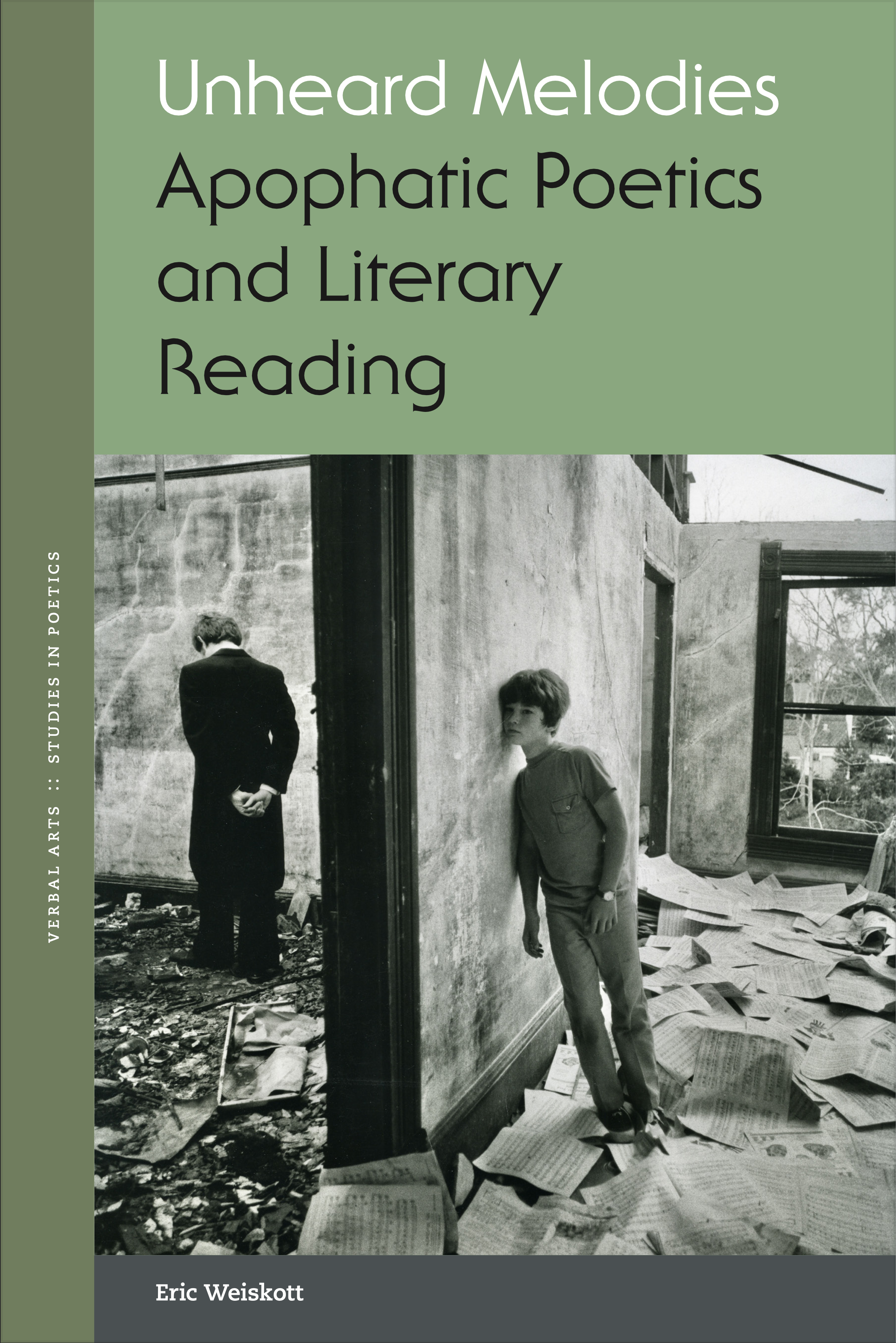
from the inside flap:
Unheard Melodies is an essay in comparative poetics. The book draws together readings of fourteenth- and twenty-first-century poetry, from Chaucer and Langland to Claudia Rankine and Ben Lerner, to reframe literary methodologies. Weiskott works through the tension between lineage and family resemblance, between mounting a literary-historical claim to connect old poetry to new and suspending claims of influence in order to draw out similarities in the practice of poetry writing across disparate times and places. The chapters show how premodern English verse, from Chaucer’s rhyming lyrics to the alliterative verse of the anonymous Sir Gawain and the Green Knight, supplies a forgotten prehistory for contemporary poetic styles.
Pivoting historically around John Keats’s translation of Christian theology into lyric poetry, Unheard Melodies concerns the paradoxical power of literature to represent what literature cannot represent: novels no one can read, lyrics no one can hear, syllables no one can pronounce, experiences no one can have, and more. In reading for these and other “apophatic effects,” Weiskott maps the spectrum of present absences possible in literature and song, including Nabokov’s novels and Bob Dylan’s music. Proposing theological negativity in the Christian tradition as both source and analogue of literary styles, the four parts of the book track apophatic poetics through four critical keywords: lyric, meter, close reading, and career.
contents
Preface
Introduction: Literature and the Inapprehensible: A Genealogy
Part I. Lyric
1 Embedded Lyrics: Geoffrey Chaucer and Ben Lerner
2 Negative Lyrics: Lerner, Anne Carson, Prageeta Sharma, and Wulf and Eadwacer
3 Missing Lyrics: Chaucer and Claudia Rankine
Part II. Meter
4 Phantom Syllables: English Alliterative Verse
5 Metrical Duck-Rabbits: The Old English Charm Against a Wen and Later Poems
6 Unhinging the Pentameter: Chaucer and Edmund Spenser, John Metham and Wallace Stevens
Part III. Literary reading
7 Indecipherable Inscriptions: Beowulf and St. Erkenwald
8 The Poetical Design is broken”: The Form of William Langland’s Piers Plowman
9 Unreadable Novels: Vladimir Nabokov
Part IV. Career
10 “Interference heard as music”: Destrangement and Intermediality in Contemporary American Poetry (Lerner, Rankine, and Elizabeth Willis)
11 “Everything is broken” (I): Mid Fourteenth-Century Alliterative Verse (Langland, the Gawain Poet, and William of Palerne)
12 “Everything is broken” (II): Midcareer Bob Dylan
Coda
endorsements
“Unheard Melodies is a dazzlingly energetic engagement with the things we call literature. This is an enlivening experiment, authorized and sustained by the author’s double commitment to scholarly thoroughness and self-reflexivity.” —Julie Orlemanski, author of Symptomatic Subjects: Bodies, Medicine, and Causation in the Literature of Late Medieval England
“This book makes a thrilling experiment: What happens when we read fourteenth-century alliterative verse next to twenty-first-century lyric poetry? Weiskott is a friendly, witty, and immensely knowledgeable guide, and this adventurous swerve across periods and specialties brings out imaginative affiliations between poets as disparate as Chaucer and Rankine.” —Walt Hunter, author of Forms of a World: Contemporary Poetry and the Making of Globalization
 Eric Weiskott