Middle English keyboard

I have defined a custom input source (aka keyboard layout) for Mac OS to enable me to type the premodern English characters ash (æ, Æ), eth (ð, Ð), thorn (þ, Þ), and yogh (ʒ, Ʒ). This is essential for my research, as otherwise I would have to copy and paste each character each time I type a block quotation or produce an edition of a poem. Now that I’ve gotten used to the custom keyboard I can type Middle English as fast as I type Present-Day English.
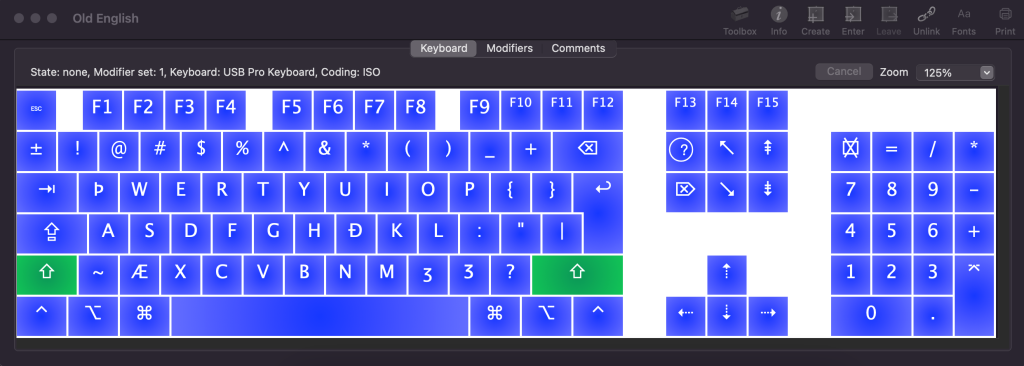
my custom keyboard layout for Early English

I defined the keyboard using the following substitutions: ash mapped onto z, eth mapped onto j, thorn mapped onto q, and yogh mapped onto < (lowercase) and > (uppercase). (The letters j, q, and z are rare in Old and Middle English.) If I had it to do again I might have mapped yogh onto x, also rare in Old and Middle English; but I am too used to the layout to want to change it now. I previously replaced v, which is not used in Old English, with wynn (ƿ, Ƿ). As I work more in Middle English than Old English these days, and wynn went defunct before the Middle English centuries, while v was used in more words, it is more important for me to have v available within the custom keyboard.

Here is the latest version of my keyboard layout in .keylayout format for anyone to use. Maybe this will be helpful to the medievalist readers. If you’d like to modify it at all, I recommend the program Ukelele.

To install on a Mac, copy the file into Library > Keyboard Layouts or create this subfolder. Then activate the layout by visiting System Settings > Keyboard > Text Input > Input Sources > Edit > “+.” The custom layout should appear under Others with the name Old English. It is then a simple matter of defining a keyboard shortcut to toggle between the regular layout and the Early English one. I use command + spacebar, which is convenient.

a little project

A few of the rare books I’ve purchased recently arrived with mylar film protective covers. It looks snazzy and protects the books from damage due to wear, dirt, and light, so I started looking into gathering the materials that would be needed to do this myself. After watching this instructional video, I assembled:

  • 2-mil thickness archival film in individual foldable sheets
  • 3-mil thickness archival film on a 100′ roll
  • hobby knife
  • self-healing cutting mat
  • ruler
  • tape

It was quite relaxing! I forgot how much I enjoy crafting. I started with my oldest books and then ended up creating covers for some of the paperbacks I use most in the classroom, to prolong their shelf life. I used the thinner film for smaller and newer books and the thicker film for the bigger and older ones. For the new books and the paperbacks I taped the film to the book, whereas I left the film loose for more rare materials.

Rankine/Lowell

I have a new note out at The Explicator [free epub / permalink] on the section of Claudia Rankine’s Citizen that engages with Robert Lowell’s Life Studies. My note, “Claudia Rankine and Robert Lowell, Again,” supplements a PMLA article by Kamran Javadizadeh by pointing to a little-known or unknown prior version of the Citizen section, published in the poetry magazine AGNI. I provide a full collation of the early publication with Citizen’s text.

This is the first scholarly output from the contemporary half of my current book project, Unheard Melodies. My book brings together fourteenth- and twenty-first-century poetics.

alliterative verse / avant-garde

I have a new curated collection of poems, premodern and contemporary, up at Poetry Foundation. Come for the Anne Carson; stay for the Piers Plowman. This was a lot of fun to pull together. It is inspired by my current book project, which likewise juxtaposes premodern and avant-garde contemporary poetry, but there are many poems in the collection not discussed in the book (and vice versa).

From the introduction:

So many of the poems brought together here, premodern and contemporary, travel that circuit between paying rent and creating art: the demands of the aesthetic economy balanced uneasily against the demands of the economy-economy. The 20th- and 21st-century poems in this collection broach a transtemporal communication through which readers can receive “a modern letter sent from antiquity” (Willis, “Tiptoe Lightning”). Certain time-bending passages in St. Erkenwald and other alliterative poems anticipate the linkage, as if these distant poems were expecting us all along.

PhD pay

I have a new statistical article in Profession and a companion op-ed in Chronicle of Higher Ed reflecting research I conducted last year into English PhD stipends. I learned that many English PhD candidates make only $25,000 (the national median), or less. A cost-of-living adjustment makes many programs located in expensive cities and suburbs look less generous.

I thank the many Directors of Graduate Studies and other administrators and department leaders who shared information and discussed my report with me prior to publication.