Saint Kenelm, illustrated

My note, “Saint Kenelm in an Imaginative Illustration,” appears in Notes and Queries. The note concerns a twelfth-century illustration of Kenelm, also featured on the cover of my first book. Here’s the opening:

Oxford, Bodleian Library, MS Douce 368 (mid or late twelfth c.) contains one of eight complete surviving copies of the Vita et miracula Sancti Kenelmi (1066–1075). The Vita is the earliest substantial account of the career of Kenelm, whose story would go on to feature in the South English Legendary and later English and Anglo-Latin texts. The narrative recounts Kenelm’s premonitory vision, decapitation, surreptitious burial, and posthumous rediscovery. In the climactic scene, the location of the saint’s murdered body is divulged to the pope in Rome by a dove carrying in its beak ‘a snow-white parchment inscribed with golden letters in English’ (‘niueam menbranam aureis litteris anglice inscriptam’, §10). In Douce 368 and other early manuscripts of the Vita, the English inscription is reported as a rhyming Latin couplet. However, three thirteenth- and fourteenth-century manuscripts gloss the passage with an English alliterative couplet: ‘In Klent Koubeche | Kenelm kunebearn/ liy under yorne | heaved bereved’ (‘In Clent Cow-valley, Kenelm the royal scion lies under a thorn-bush, decapitated’). The English alliterative couplet survives elsewhere in a free-standing late twelfth-century copy. An early eleventh-century application of the epithet cynebearn to Kenelm suggests that the alliterative poem predates the Vita. Like Cædmon’s Hymn, another miraculous English poetic utterance, the alliterative snippet on Kenelm seems to have moved from memory (in the earliest manuscripts) to the margins (in later manuscripts) and finally to the main text (in later redactions of the legend).

The Douce 368 text of the Vita opens on folio 80r with a historiated initial D depicting a resplendent Kenelm crowned and enthroned, a globus cruciger in one hand and a lily in the other. A dove with wings spread and beak open occupies the upper right corner of the illustration, over Kenelm’s shoulder. To the extent that they take notice of such details, scholars offer contradictory interpretations of the function of the dove. A note in a modern hand in the manuscript describes ‘the dove bringing the narrative of his murder’, evidently mistaking Kenelm for the Pope. F. W. Potto Hicks remarks only that ‘the dove refers to the legend of the letter announcing his death being carried to Rome’. Miriam Gill offers, ‘a bird to the right of his head must refer either to his premonitionary dream or to the dove which brought the news of his death to the Pope’. Rosalind Love, in a thorough description of the manuscript, has Kenelm ‘attended by a bird bearing something in its beak—perhaps the letter delivered to the pope in Rome’. Judith Collard sees the dove ‘touching his crown’.

Each of these interpretations captures a partial truth, but I see a possibility to improve on them by more closely connecting the illustration to the narrative of the Vita and by allowing the illustrator more artistic license. […]

The opening of the Vita et miracula Sancti Kenelmi in Oxford, Bodleian Library, MS Douce 368 (mid or late twelfth c.). St. Kenelm, enthroned, holds orb and lily; a dove places a crown on his head.
an oxymoron in Beowulf

My note, “An Oxymoron in Beowulf,” appears in ANQ: A Quarterly Journal of Short Articles, Notes and Reviews. This note identifies an oxymoron in the description of Beowulf’s final showdown with the dragon. Here’s the text of the passage in question and the opening frame of the note:

ðær he þy fyrste     forman dogore
wealdan moste     swa him wyrd ne gescraf
hreð æt hilde

                        (Beowulf 2573-75a)

In commentary on this difficult passage, scholars have focused on the syntactical function of the two ambiguous adverb/conjunctions ðær “there; where” and swa “thus; as” and the two adverbial phrases þy fyrste “on that occasion” and forman dogore “for/on the first day/time.” In order to make sense of the passage, many critics give ðær the uncommon meaning “if,” and some construe swa as introducing a relative clause, a difficult interpretation that lacks clear support elsewhere in the corpus. Some scholars also take forman dogore instrumentally with wealdan, thereby spoiling the evident syntactical parallelism between þy fyrste and forman dogore.

Yet the primary difficulty is surely that wealdan means just the opposite of what narrative context seems to require here: “rule,” not “succumb.” […]

a poetic compound

My article, “Grass-Bed: A Poetic Compound in the Alliterative Tradition,” appears in Anglia. This article synthesizes the study of meter and the study of poetic vocabulary through a case study of one rare poetic word closely affiliated with the alliterative tradition from Old to Middle English. Here’s the abstract:

The compound word grass-bed occurs four times in Old and Middle English texts. In each case, grass-bed occurs in an alliterative poem; in each case, the word is used as a kenning for a site of bodily death (a battlefield or a grave). The chronologically and metrically uneven distribution of poetic words like grass-bed in the corpus of medieval English texts raises questions about the reliability of the extant written record, the historical resources of individual writers, and the cultural meanings of poetic traditions. Meanwhile, research in alliterative metrics has begun to suggest that the division of medieval English literary history into Old and Middle subperiods masks fundamental continuities between pre- and post-Conquest alliterative verse. Progress in alliterative metrics refocuses the historical problems attendant upon rare poetic words like grass-bed. Conversely, against the backdrop of technical argumentation in the field of metrics, the study of words offers a second way of understanding the continuity of the alliterative tradition. This article explores connections between metrical history and lexical history via a case study of one especially long-lived and metrically marked poetic word.

a missing term in metrics

My article, “Systematicity, a Missing Term in Historical Metrics,” appears in Language and Literature. This article introduces a new technical term in historical metrics in order to address and connect two of the most persistent problems encountered by modern metrical specialists. The title of the article pays homage to a seminal essay in evolutionary biology, Stephen Jay Gould and Elisabeth S. Vrba’s “Exaptation—A Missing Term in the Science of Form.” Here’s the abstract:

This essay identifies two persistent problems in the historical study of meter—nonconformant metrical patterns and metrical change—and offers a new term as a conceptual tool for understanding their interdependence. The term ‘systematic’ denotes metrical patterns that conform to synchronically operant metrical principles. The corresponding term ‘asystematic’ denotes the minority of actually occurring metrical patterns that fall outside the metrical system as such for historical reasons. All systematic patterns are necessarily metrical, but not all metrical patterns are systematic. It is argued that the systematicity/metricality distinction in historical metrics is analogous to the regularity/grammaticality distinction in historical linguistics and similarly fundamental to historical analysis. By introducing a new technical term, this essay seeks to shift the metrist’s object of study from the metrical system qua system to meter as a complex historical experience. The value of the concept of systematicity is illustrated through three case studies in asystematic metrical patterns from early English poetic traditions: verses with three metrical positions in Beowulf, lines with masculine ending in Middle English alliterative verse, and the infamous ‘broken-backed lines’ in the pentameter of John Lydgate. In each case, it is argued that the contrast between systematic and asystematic metrical patterns illuminates the diverse historical and perceptual negotiations that inevitably lie behind metered texts.

counting and scanning

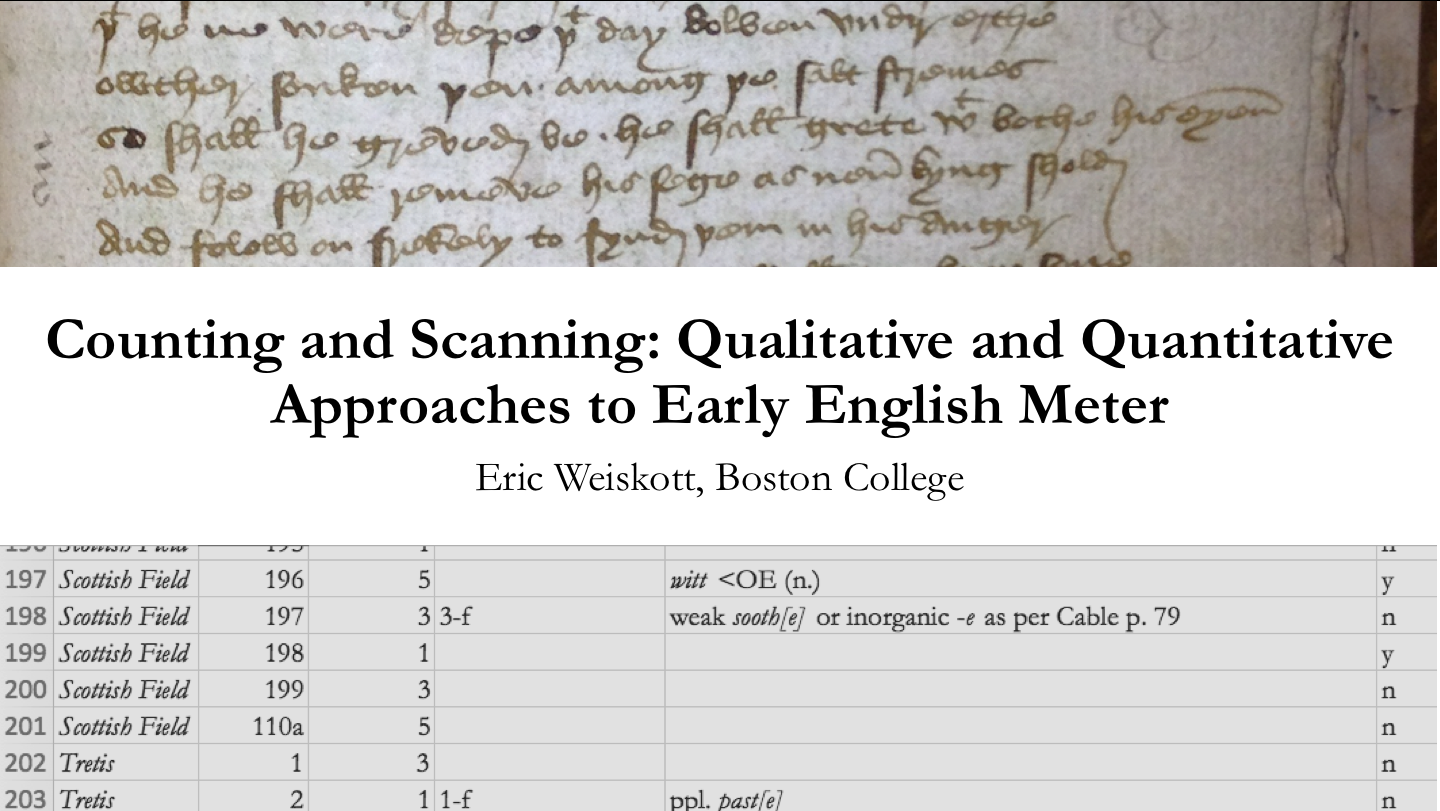
This weekend, I presented a paper at Digital Britain: New Approaches to the Early Middle Ages in Cambridge, MA. My gratitude to Sam Berstler, Joey McMullen, and Erica Weaver for the invitation, and for organizing the conference. My paper, “Counting and Scanning: Qualitative and Quantitative Approaches to Early English Meter,” is an essay in the philosophy of science, focusing on the use of quantitative reasoning in a specialized field of literary study. Here’s the opening frame:

This is a paper in defense of counting in literary studies. It’s also a paper about why counting needs defending in literary studies in 2016. First, I’d like to connect these topics to the conference theme.

The so-called digital turn in academic knowledge production poses a material challenge to the methodological status quo of the humanities. Digital technology makes a bold promise: the quantification of human experience. For constituents of the status quo, the promise of digital technology seems more like a threat. Many humanists worry about what is lost when the richness of culture and the arts is reduced to data. For others, digital tech enables the humanities to live up to their potential. To take an egregious example, Franco Moretti’s ‘distant reading’ does not merely claim to be a good method of reading literature; it claims to be the best method. In promoting statistical approaches to literary history, Moretti taps into philosophical attitudes that predate the digital. His aggressive empiricism is at once the attraction and the scandal of distant reading.

Thus the digital turn irritates a long-standing tension in humanistic study between qualitative and quantitative methods. I propose to explore this tension by focusing on a field of inquiry that bears an unusual relationship to it. Metrics, depending on your perspective, is either the field entrusted with explaining what makes poetry poetry, or the field charged with inferring an organizational system from linguistic patterning. Metrical scholarship combines qualitative and quantitative reasoning in a way that has become uncomfortable in literary studies.

Discomfort with the modus operandi of metrics is acute in the case of early medieval literature, whose systems of formal organization lie at a great cultural remove from those of modern literature. In reconstructing early medieval meters, the value of modern experiences of poetics, and hence the network of assumptions underlying data collection, is always open to question. About the meter of Beowulf, for example, it is currently possible to hold any one of a number of mutually contradictory theoretical views. Moreover, Old English metrical theories cluster in two incommensurable research paradigms, one continuously elaborated since the nineteenth century, the other disclosed for the first time in 2008 (see Cornelius, “The Accentual Paradigm in Early English Metrics”). Metrists disagree, and they disagree about why they disagree. For many literary scholars, meanwhile, metrics is a field that deploys the rhetoric of accumulation to make exaggerated claims on historical truth.

counting and scanning header

In light of these problems, what I’d like to do this morning is to sketch the function of counting in metrics, with reference to my research on English alliterative verse. I have two goals: to affirm the role of quantitative reasoning in literary study, and then to set a certain limit on that role. In what follows, I identify and address two philosophical challenges to counting as a critical method. One challenge comes from the right, framed in the language of neopositivism; the other comes from the left, framed in the language of poststructuralism. I contend that the neopositivist and poststructuralist positions both miss the full significance of counting as a way of getting at “the heart of a poem,” in the words of Simon Jarvis. Ultimately, I’ll argue that metrical study explodes the distinction between qualitative and quantitative approaches to literature.