I have a piece out today in Paul Sturtevart’s Public Medievalist on Britishness as a (proto-)racial category in medieval Britain, with a glance ahead at twenty-first-century politics.
political fictions
Medieval literature shows ways out of the dystopian novel Trump is forcing us to inhabit
President Trump’s new executive order on immigration, issued today, closely resembles the January executive order that preceded it. A federal judge in Washington state halted the first order on constitutional grounds, a decision upheld by a 9th Circuit Court of Appeals decision last month.
The first executive order, according to some political observers, was straight out of a dystopian novel. Titled “Protecting the Nation from Foreign Terrorist Entry into the United States,” the order immediately suspended all travel to the U.S. from Syria and six other Muslim-majority countries. The move appeared hastily executed and lacked a coherent rationale from the perspective of national security. Why those seven countries, critics wanted to know, and not other Muslim-majority countries? Why bar entry to green-card holders, who had already been intensely vetted? Why provide no warning, stranding thousands of legal immigrants and long-time permanent residents abroad?
Today’s order has the same title and the same purpose. Iraq has negotiated an exit from the list, and the second order, unlike the first, does not specify an indefinite ban on Syrian immigrants. The new order goes into effect in ten days.
In official statements regarding the first order, the White House insisted that the ban was not a ban, and especially that it was not a Muslim ban—though the text of the January order named only Muslim-majority nations and allowed for exceptions “when the person is a religious minority in his country of nationality.” These and similar bald self-contradictions elicited comparisons to George Orwell’s Nineteen Eighty-Four and other works of fiction that imagine the coercive power of a fully totalitarian state. Nineteen Eighty-Four currently sits at #22 on Amazon’s bestseller list. Margaret Atwood’s Handmaid’s Tale is #37; a television series is forthcoming on Hulu. Nineteen Eighty-Four had topped the list following the January order. People are hungry for answers and precedents.

In place of the exceptions for religious minorities, section 1.b.iv of the March order defends the January order against charges of religious discrimination and Islamophobia. The language is worth quoting in full:
(iv) Executive Order 13769 did not provide a basis for discriminating for or against members of any particular religion. While that order allowed for prioritization of refugee claims from members of persecuted religious minority groups, that priority applied to refugees from every nation, including those in which Islam is a minority religion, and it applied to minority sects within a religion. That order was not motivated by animus toward any religion, but was instead intended to protect the ability of religious minorities — whoever they are and wherever they reside — to avail themselves of the USRAP in light of their particular challenges and circumstances.
Note that the first executive order named no countries “in which Islam is a minority religion”! Notice, too, how important it is for those who crafted both orders to dispute the (blatantly) hateful motivation of the first order after the fact. Section 1.b.iv exemplifies this administration’s agonistic relationship with the truth. Expect Nineteen Eighty-Four to see another spike in sales.
Reference to dystopian novels is appropriate not so much because Nineteen Eighty-Four predicts Trumpism as because Trump behaves like a caricature, bypassing the details of policy in pursuit of ratings. The immigration executive orders, like other actions taken by Trump in the first months of his presidency, seem motivated by a desire to rile up his base rather than by any informed political program. The settings in which his actions make sense, and to which they are directed, remain the Twitterverse and the well-attended rallies of the faithful.
The idea that the immigration bans make American citizens safer could be charitably described as a fantasy. No national of any of the six (or seven) countries has killed anyone in a terrorist attack in the United States in the past 15 years. Most years, more Americans die at the hands of toddlers with guns than perish by terrorist violence. This includes domestic terrorism, which neither version of “Protecting the Nation” addresses. As often in politics (and fiction), ideology masquerades as policy. The executive orders amount to an emotional indulgence for xenophobic factions on the right. Therein lies their fictional essence. Of course, that is no consolation for those affected by the bans nor their families in the United States and abroad. Fiction is not an escape from reality but a way of experiencing it. Emotional indulgences always seem to come at the price of someone else’s pain.
For the time being, Americans (and the world) may be locked in a Nineteen-Eighty-Four-meets-hotel-commercial storyline. Kellyanne Conway’s phrase “alternative facts” set off alarm bells in January but actually falls short of Trump’s own brand of doublethink. According to Trump, there is no verifiable reality to which his discourse is alternative. “Any negative polls,” he tweeted last month, “are fake news.” Ipso facto, apparently. If the departure from Bush-Clinton-Obama gentility seems sudden, that is to some extent because Americans have spent the previous decades asleep, unable or unwilling to diagnose less well-advertised Orwellian developments. From his predecessors, Trump inherits a vast machinery of immigration laws, drones, and detention centers. He has only to use it.
Looking back beyond 20th-century dystopian fiction can suggest other, more constructive forms of collective political imagination. In 14th-century England, Syria was celebrated as the homeland of the founders of Britain. According to a version of the wildly popular medieval historical narrative known as the Brut, Britain was discovered long before the birth of Christ by 33 Syrian sisters. Their father, the story goes, had married them off to 33 Syrian noblemen, whom they despised. The husbands beat their wives, but “they behaved even worse than before.” Their father, the king of Syria, was ashamed. He sent for his 33 daughters and told them to shape up or “lose his love forever.” The women responded by killing their husbands in the middle of the night, whereupon they were banished from Syria and set sail for Britain. The eldest sister, Albina, gave her name to the new country: Albion.
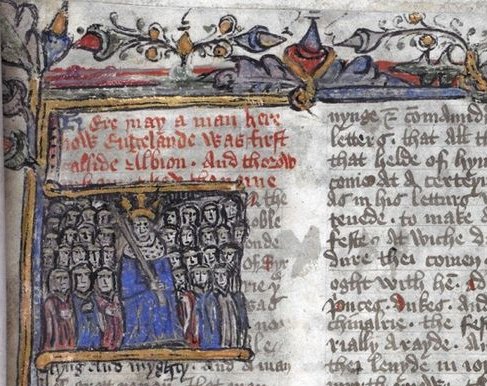
Washington, D.C., Folger Shakespeare Library, MS Ogden 24
The Albina legend is one of many origin stories that circulated in medieval England. In an earlier version, the women are said to come from Greece. Later on in the Brut, Britain is founded by the eponymous Brutus of Troy, great-grandson of Aeneas. That Albina and Brutus belong to legend rather than historical fact does nothing to mitigate their power as ideas. By tracing British polities back across the sea to Greek or Syrian nobility and Trojan conquerors, medieval English readers connected their island—situated at the edge of the known world—to cosmopolitan culture. For subjects with something to prove, immigration is not a problem but a necessity.
The medieval English view of Syria was by no means egalitarian, however. After arriving on the island, Albina and her sisters become “wondrous eager” for men, lie with the Devil, and engender a race of giants whom Brutus must later eradicate. Temporal and physical distance from ancient Syria enabled readers of the Brut to project fantastical qualities onto the 33 immigrant sisters. The Albina legend participates in then-current discourses surrounding race, gender, and the East.
At the same time, the story typifies the possibilities of literary imagination before modern nationalism. Scholars of medieval culture disagree about whether it makes sense to speak of ‘nations’ in the Middle Ages. If 14th-century England was a nation, it was a different kind from modern global powers like the United Kingdom and the United States. A monarchy administered by a hypermobile, multilingual elite, late medieval England was, in the words of Derek Pearsall, “part of the continent, and not a very important part” (Old English and Middle English Poetry, p. 85). The political imperative behind the Albina legend was the need to disavow Britain’s geographical and cultural marginality. When Chaucer entered the literary scene in the 1360s, he didn’t assume the cultural superiority of the English language. On the contrary, his provocation consisted in writing haute French and Italian literature, but writing it in English.
Intervening between Chaucer and our current literary/political moment is the idea of the nation in the modern sense, an idea over which much ink has been spilled and for which countless people have died. Most political thought and action since the Enlightenment, from Mandela to Mussolini, has unfolded inside the idea of the nation. Trump’s ascendancy, like the result of the Brexit referendum in the UK, represents a rejection of late-century globalization and nostalgia for a nationalistic status quo. “Protect the Nation” is “Make America Great Again” and “America First” translated into an executive order. It is the arbitrary exercise of spiteful isolationism. Either version of the document could be fiction, if their effects on thousands of innocent lives were not so palpable. The protests at airports and across the country in January had a symbolic flavor, as protests tend to do. There were allusions to Lady Liberty, Voldemort, Mordor, and Orwell. The symbolism of literary fantasy, empty as it often must be, made a strangely appropriate response to such a destructive empty gesture. Expect more of the same this week.
Trump’s campaign platform named real problems in America—income inequality, the entrenchment of a political class, the centralization of cultural power, terrorism—but proposed to solve them with the fantasy of a nation that becomes an island unto itself. Hence the resonance with the hypernationalized future landscapes of Nineteen Eighty-Four and The Handmaid’s Tale. Hence the Hulu series, whose viewers will presumably investigate their authoritarian reality by entering a yet more authoritarian fictional world. Medieval literature serves as a reminder that the political imaginary can exist beyond the traps and clichés of closed borders.
there’s nothing medieval about Trump
I have a piece out today over at David M. Perry’s How Did We Get Into This Mess?, on what is really at stake in calling the Trump administration ‘medieval.’
the dangers of echo chambers in newsrooms
Two days ago, Nicholas Kristof published “The Dangers of Echo Chambers on Campus.” As you might expect from a New York Times op-ed, it’s typical of public discourse surrounding its topic. Kristof argues that campuses are liberal bubbles in need of bursting. This is, in fact, what conservatives have been saying for decades; the difference is that Kristof pitches the argument as avuncular advice, liberal to liberal. “Too often, we embrace diversity of all kinds except for ideological,” he admonishes his readers in the first person plural.
Never mind that his sole example, Oberlin College, is wildly unrepresentative of actually existing American higher education. It’s more similar to Harvard, where Kristof was an undergraduate, or Oxford, where Kristof was a Rhodes Scholar, or Boston College, where I teach.
Never mind that focusing on disembodied ideology at Oberlin, where 80% of students are white and 89% do not qualify for Pell grants, allows Kristof to avoid addressing the underrepresentation of people of color and poverty- and working-class people (these categories of course intersect) on elite campuses and, correspondingly, the experiences and opportunities afforded to these people on less well-funded campuses.
Besides, in a rhetorical irony that is quintessentially 2016, the ostensible targets of the argument have already done the introspection being recommended. I attended Wesleyan University. During my time there, the relationship between campus discourse and public discourse was a constant topic of conversation. Ideological battles on campus consciously played out against the backdrop of a public sphere that derided places like Oberlin and Wesleyan as liberal bubbles. The ‘real world’ loomed large, not only as a rhetorical ploy in difficult conversations, but also as the reality everyone would face after graduation. Student activists are already doing the hard work that Kristof blithely recommends as if for the first time.
Kristof’s piece has generated significant pushback, probably more than it deserves. It isn’t even the first time he himself has made the argument. I want to suggest one reason for the disproportionate response: Kristof’s chiding, can’t-we-all-just-get-along tone epitomizes a news media bubble whose default mode is Everything Is OK. It’s the same bubble in which Donald Trump stood no chance of winning a presidential election.
Everything Is Not OK. A few weeks ago, police used water cannons on Dakota Access Pipeline protesters in Cannon Ball, ND, in subfreezing weather, injuring hundreds. Whether you find yourself on the side of the police or the protestors, the violent confrontation has to indicate that Everything Is Not OK.
Betsy DeVos, the appointee for education secretary, rose to political prominence by creating so many charter schools in Detroit that the quality of education at both charter schools and public schools deterioriated. Whether you support or oppose the charter school movement, the appointment of a billionaire lobbyist with a questionable track record and no experience as a teacher or school administrator has to indicate that Everything Is Not OK.
Scott Pruitt, the appointee to head up the Environmental Protection Agency, denies the scientific consensus on human-caused climate change for political reasons. There may be room for debate on the precise extent of climate change and the most effective political response to it, but Scott Pruitt is not in the room. He’s not even in the building. Regardless of your position on energy reform or the epistemological limits of modern science, the appointment of a dedicated opponent of scientifically informed policy to head the EPA has to indicate that Everything Is Not OK.
All of these developments deserve more media coverage than they’re getting. Meanwhile, Kristof argues that it’s liberals at Oberlin who are standing in the way of an ideologically robust public discourse. Only within the news media bubble could such a notion appear as a hard truth.
My interest in public discourse in 2016 grows out of my research on medieval English political prophecy. In fifteenth-, sixteenth-, and seventeenth-century Britain, prophetic discourse furnished common ground for the most and least powerful members of society. It took the form of social protest but was soon co-opted by elites as political propaganda. Prophetic writing crowned kings and got everyday people killed. The ideological underpinnings of prophecy, its forms of epistemic closure, can be obvious to us now, because prophecy comes from a political world we no longer inhabit. The ideological underpinnings of public discourse in 2016 can be more difficult to ascertain. An op-ed seeming to recommend the piercing of an echo chamber might turn out to be yet another reverberation in an echo chamber.
In my experience, echo chambers on campus mostly don’t exist, or if they do they are not dangerous in any widely accepted definition of the word. Echo chambers in our institutions of mass media, and our collective inability or unwillingness to recognize them, are as dangerous as ever.
 Eric Weiskott