tradition and literary history

My first book, English Alliterative Verse: Poetic Tradition and Literary History, is published by Cambridge University Press (2016).
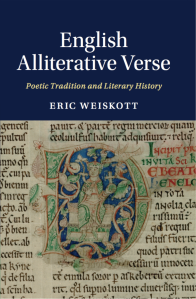
Eric Weiskott, English Alliterative Verse: Poetic Tradition and Literary History

English Alliterative Verse tells the story of the medieval poetic tradition that includes Beowulf, Piers Plowman, and Sir Gawain and the Green Knight, stretching from the eighth century, when English poetry first appeared in manuscripts, to the sixteenth century, when alliterative poetry ceased to be composed. The book draws on the study of meter to challenge the traditional division of medieval English literary history into ‘Old English’ and ‘Middle English’ periods. The two halves of the alliterative tradition, divided by the Norman Conquest of 1066, have been studied separately since the nineteenth century; this book uses the history of metrical form and its cultural meanings to bring the two halves back together. In combining literary history and metrical description into a new kind of history called ‘verse history,’ English Alliterative Verse reimagines the historical study of poetics.

Individual chapters consider (1) Beowulf; (2) prologues to Old English poetry; (3) Lawman’s Brut, an alliterative verse chronicle of the twelfth century; (4) prologues to Middle English poetry; (5) St. Erkenwald, an alliterative romance of the fourteenth or fifteenth century; and (6) the alliterative tradition in the sixteenth century.

A version of Chapter 3 appears in an edited volume devoted to Lawman’s Brut. I have also edited two late fifteenth-century alliterative poems, The Ireland Prophecy (Studies in Philology) and The Vision of William Banastre (in an edited volume devoted to early English poetics), and I have brought to light two sixteenth-century excerpts from Piers Plowman (Review of English Studies). These new texts inform the arguments of Chapter 6. Four articles bring the arguments and methods of the book to related topics: the relationship between metrical history and language history (Modern Philology); the meter of Piers Plowman (Yearbook of Langland Studies); the history of modern scholarship on medieval verse (ELH); and the historical study of poetics (Modern Language Quarterly).

before prosody

My article, “Before Prosody: Early English Poetics in Practice and Theory,” appears in Modern Language Quarterly. This article draws on the methods and arguments of my first book to reconsider the historical study of poetics in general. Specifically, the essay makes a medievalist contribution to the emerging subfield known as ‘historical poetics.’ I workshopped an earlier version of this essay while visiting Stanford University. Here’s the abstract:

Since the sixteenth century, the history of English poetics has had two sides: a history of theory and a history of practice. Contemporary literary scholars are mapping new connections between the history of theory and the history of practice, under the rubric of “historical poetics.” Thus far historical poetics has been most strongly associated with the study of nineteenth-century poetry. This essay takes a longer view onto the histories of English poetry from the perspective of early English verse. Medieval English poets practiced literary form at a time when vernacular poetics had not yet become an academic subject or a sustained cultural discourse. This essay offers medieval English poetry as a case in point for historical poetics, thereby bringing a different literary archive to bear on methodological debates about the historical study of poetics. Three case studies, centered on alliterative verse, explore what is distinctive about the cultural work of early English poetics.

phenomenological poetics

I’d like to use this post to introduce a general methodological approach in the field of poetics. Much of my work on early English poetry thus far has been concerned to analyze poetic features not as objective linguistic structures but as mental events. Meter as a mental event; syntax as a mental event; wordplay as a mental event. This general approach to poetics might be termed ‘phenomenological poetics.’*

In pursuing phenomenological poetics, I find myself producing scholarly work that cuts across the structuralism/poststructuralism and formalism/historicism dichotomies. On the one hand, phenomenological poetics differs from most strands of structuralism in refusing to externalize form. For example, my article on Old English poetic syntax mounts a historicist argument against modern editors who propose to chop poetic texts into modern sentences. I argue that certain kinds of syntactical complications are stylistic effects purposefully offered to medieval minds, not syntactical problems accidentally offered to modern textual criticism. To make this argument, however, I build on the findings of modern linguistics and the study of syntax: it’s an argument about the history of form that recognizes form but tries hard not to reify form.

On the other hand, phenomenological poetics operates differently from most strands of poststructuralism, too. For example, my first book tracks the history of the English alliterative meter from the seventh to the sixteenth century. Where poststructuralists often express skepticism about the reality of meter as an object of inquiry, I discuss meter as a real mental event. I consider my work to be materialist, with the understanding that the materials are not pronunciations, spellings, syllables, or even metrical notations but forms of expectation and perception. Meter, for me, lives in the mind, but it lives in the mind in formally and historically specifiable ways. My book argues, in part, that we should not allow that formal and historical nuance to be flattened out by skepticism about our ability to capture it. In phenomenological poetics, questions about literary form and questions about literary history simply coincide, inasmuch as recovering medieval thought processes about poetry is an inherently formal and historical task.

In describing my approach as materialist but concerned with mental processes, I am, of course, coming close to the interdisciplinary field known as cognitive poetics. The cognitive sciences are those dealing with the material that grounds the mental. Thus far I have not connected my research in poetics with the cognitive sciences, but I have learned a great deal from metrists who have: Nick Myklebust, for example.

*A quick Google search reveals that others have used the phrase in a different sense, to refer to poetry that itself engages phenomenological philosophy or phenomenological experience.

Stanford visit

Eric Weiskott at Stanford

photo credit: Elaine Treharne

This past week, I visited Stanford University as a Text Technologies Fellow. While at Stanford I also spoke to the Workshop in Poetics, recorded a video interview for a developing digital resource for the study of prosody, and guest-lectured on early English alliterative meter in English 301B, Love and Loss in Early English, 900-1300. My gratitude to Elaine TreharneArmen DavoudianRoland GreeneNick Jenkins, and Mary Kim for these invitations and to Armen, Mary, and Daeyeong (Dan) Kim for making local arrangements. Here is a summary of my visit on Stanford’s website.

As a Text Technologies Fellow, I gave a lecture to the Stanford CMEMS Workshop entitled “The Old English Exeter Book and the Idea of a Poem.” This lecture represents new thinking at the nexus of poetic meter, manuscript form, and the history of ideas. My thanks to the attendees for helpful questions and criticisms. Here’s a modified version of the opening frame of the talk:

As a visitor to the Workshop in Poetics, I presented a work in progress entitled “Before Prosody: Early English Poetics in Practice and Theory.” This essay relates the conclusions of my first book to the emergent research paradigm known as ‘historical poetics.’ My thanks to the members of the Workshop for incisive questions and comments. Here’s an abstract:

Scholars of Victorian poetry have called for a ‘historical poetics’ that would reevaluate the received narrative of English literary history by recovering alternate ways of theorizing and experiencing poetic form. This essay takes a longer view onto the histories of English poetry from the perspective of Old English and Middle English verse. The primary purpose of the essay is to offer medieval English poetry as a case in point for historical poetics, thereby bringing a different literary archive to bear on critical conversations about the theory and practice of English versification. The contribution of this essay to the field of historical poetics will be to indicate a constitutive gap between the practice and theory of verse. Through three case studies drawn from ongoing research on the alliterative tradition, I seek to demonstrate what is distinctive about the cultural work of early English poetics. Recognition of the ways in which modern questions fail to illuminate medieval meters is the first step toward a more capacious historical poetics.

As a contributor to a developing digital resource for the study of prosody, I discussed alliteration as a poetic device and an ornament in alliterative meter; the alliterative tradition, Old to Middle English; and the state of the field of alliterative metrics.

As a guest lecturer in English 301B, I taught a class of undergraduates and graduate students about the history of the alliterative metrical system c. 900-1200, with examples drawn from the Battle of Brunanburh (c. 937), Durham (1104-1109), and Lawman’s Brut (c. 1200). We asked how this metrical system stood around 900, how it changed between then and 1200, and how modern scholars have conceptualized these metrical principles and transformations. It was exciting to be able to help the students connect meter with the primary concerns of the seminar: linguistic form, literary style, periodization, and manuscript context.

alliterative meter and literary history

My article, “Alliterative Meter and English Literary History, 1700-2000,” appears in ELH. This article historicizes the methodology of my first book by asking how eighteenth-, nineteenth-, and twentieth-century students of alliterative poetry conceptualized the relationship between metrical history and literary history. I contend that the divergence of metrics and literary history in the late twentieth century was a direct response to 250 years of sustained interaction between the two fields. I argue that post-2000 research on alliterative meter holds out the possibility of rapprochement between literary history and philology. This article grew out of a conference presentation earlier this year. Here’s an abstract for the article:

Nicolay Yakovlev’s 2008 Oxford thesis has already been felt to mark a significant juncture in the history of the study of English alliterative meter. This essay describes Yakovlev’s conceptualization of metrical history as a paradigm shift in study of medieval English literary history. The central section of the essay charts the scholarly study of alliterative verse, 1700-2000, focusing on the braiding of political, literary, linguistic, and metrical histories. The essay concludes by considering the intellectual significance of a non-teleological English literary history and pointing out some of the shapes it might take, focusing, as throughout, on the alliterative tradition.