the authorship of St. Erkenwald

At the International Congress on Medieval Studies in Kalamazoo, MI, this past week, I participated in a panel discussion entitled “Alliterative Traditions,” held in memory of Larry D. Benson. Thanks to Susanna Fein, Daniel Donoghue, and Nicholas Watson for including me. Here I reproduce the opening frame and closing paragraphs of my contribution, “The Authorship of St. Erkenwald: Why Are We Having This Conversation?”:

St. Erkenwald is a romance in English alliterative verse, found uniquely in a late fifteenth-century manuscript anthology of hagiography. The plot of the poem is as follows: in the seventh century, Erkenwald, bishop of London, discovers a tomb beneath St. Paul’s Cathedral covered in indecipherable carvings and containing the undecayed body of a pagan judge, who begins to speak to the astounded onlookers; after interviewing him about his life and death, Erkenwald unintentionally baptizes the judge by reciting the baptismal formula while shedding a tear.

From its first printing in 1881, St. Erkenwald has often been ascribed to the anonymous poet of Sir Gawain and the Green Knight and the other Middle English poems in British Library, MS Cotton Nero A.x. The case for the Gawain poet’s authorship rests on internal evidence. Before 1965, co-authorship of St. Erkenwald and the Gawain poems was orthodoxy; after 1965, proponents of co-authorship came to occupy a marginal position in scholarship on both poems. The difference was a carefully argued essay by Larry Benson (“The Authorship of St. Erkenwald“). In my contribution to this panel discussion in Benson’s memory, I ask what is at stake in this particular philological debate.

The authorship of St. Erkenwald is a small problem with big implications for literary history. It radiates outward from the study of one alliterative poem to related issues: most immediately, the oeuvre of the Gawain poet, but also the literary culture of the Northwest Midlands in the fourteenth century, the value of style as historical evidence, the status of authorship in metrical tradition, and the increasingly suspicious literary-historical concept of an Alliterative Revival.

[…]

The irony of the co-authorship debate is that it has been unkind to St. Erkenwald, which figures in anthologies and criticism, if at all, as an optional addendum to an important foursome of poems. Like Beowulf, St. Erkenwald may have been stupendously unimportant, unread, unimitated, and quickly forgotten by contemporaries. Of course, modern scholars are under no obligation to take a medieval view of the poem’s literary merits (I certainly do not); but, equally, the poem is under no obligation to yield intelligible answers to modern questions. St. Erkenwald deserves separate treatment in any case, not because it is a work of genius that transcends its tradition, but because it epitomizes its tradition. I think Larry Benson understood this; he framed his 1965 essay as a rescue mission. “[T]he most unfortunate effect of the attribution,” he wrote, “is that it has obscured the real literary value of [St. Erkenwald]” (394-95).

My forthcoming monograph on English alliterative verse represents an extended attempt to demonstrate and contextualize the “real literary value” of St. Erkenwald, together with two earlier alliterative poems of exceptional historical significance: Beowulf and Lawman’s Brut. The only concerted close reading in a book otherwise concerned with metrical and cultural history comes in the fifth chapter, and it is devoted to St. Erkenwald. The central question of St. Erkenwald, I argue there, is the central question of the alliterative tradition: how to uncover and understand the distant past. Consequently the narrative proceeds in two discrete stages, excavation and interview. The hinge comes after line 176, precisely halfway through this 352-line poem.

The literary arguments of this chapter rely directly on Larry Benson’s withering critique of the case for co-authorship. In 2016, St. Erkenwald can stand on its own as an important and worthwhile alliterative poem. For it is in one way, at least, a more perfect poem than Sir Gawain and the Green Knight: it crystallizes the problem of history with none of the distractions of chivalric romance. In 1965, Benson dramatically redirected a critical conversation that, ironically because of his contributions to it, we are now ready to stop having.
multispectral imaging and manuscripts

My essay, “Multispectral Imaging and Medieval Manuscripts,” appears in a volume devoted to digital humanities and medieval literature and culture, edited by Jennifer E. Boyle and Helen J. Burgess. My essay introduces a new digital approach to medieval manuscripts by summarizing a Mellon-funded project in the digital humanities at Yale University. Here’s the opening section:

Debates in the field of manuscript studies often take the form of disputes over material details that are at least theoretically quantifiable: the curve of an ascender, the shape of a damaged leaf, the color of a paraph mark. Until recently, such debates were adjudicated entirely on the basis of comparison by human eyes. Paleographical and codicological research along these lines has been transformative: it remains the edifice on which rest all other forms of knowledge about medieval texts. Yet human eyes have scientifically well-understood limitations, especially as regards the perception of color. Recently, it has become possible to supplement the human eye with a digital one.

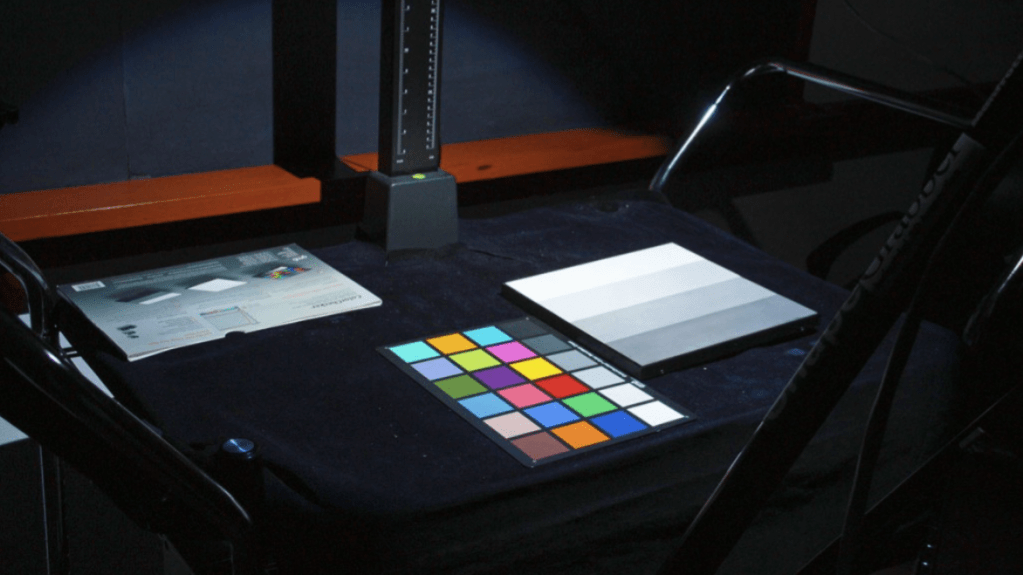
Human eyes see in three colors, whose various proportions the brain interprets as the range of colors we perceive in the world. There are finer ways of slicing up the color spectrum, however. The eyes of some species have developed to see in more than three colors, enhancing discrimination between closely similar wavelengths of light. Computers, too, can ‘see’ in many more than three colors. Digital capture of spectral information in more than three colors is known as multispectral imaging. (Hyperspectral imaging, marginally more accurate but substantially more costly and time-consuming, refers to digital capture of spectral information continuously across the color spectrum.) A non-invasive procedure involving a professional camera and a computer, multispectral imaging reveals differences in reflected light that remain invisible to human eyes. Multispectral imaging also captures data across the infrared and ultraviolet ranges, which lie, respectively, beneath and above our visible light spectrum. In other words, computers can be programmed to ‘see’ more and more finely than human eyes.

Progress in computer science thus enables the creation of new kinds of data about medieval manuscripts (among other objects of interest). These new data promise to confirm, enrich, problematize, or even invalidate the conclusions of traditional manuscript study. This essay outlines the scope and goals of interdisciplinary research at the intersection of computer science, manuscript studies, and cultural heritage preservation. It does so through an overview of a case study: a research project in the digital humanities carried out by computer scientists, medievalists, and digital preservation experts at Yale University from 2012-2015 under the auspices of an Andrew W. Mellon Foundation Scholarly Communications and Information Technology grant. Entitled Digitally Enabled Scholarship with Medieval Manuscripts, this project had three arms, of which I will discuss one, “Creating English Literature, c. 1385-1425: Inks, Pigments, and the Textual Canon.” While at Yale I served as graduate assistant for “Creating English Literature” to Principal Investigators (PIs) Alastair Minnis and Barbara A. Shailor, who were later joined by PI Ardis Butterfield. The other two arms of Digitally Enabled Scholarship with Medieval Manuscripts are “Editions of the First and Second Recensions of Gratian’s Decretum” (PI: Anders Winroth) and “A Literary History of the English Book of Hours” (PI: Jessica Brantley).

the Yale team’s technical setup for multispectral imaging of medieval manuscripts

counting and scanning

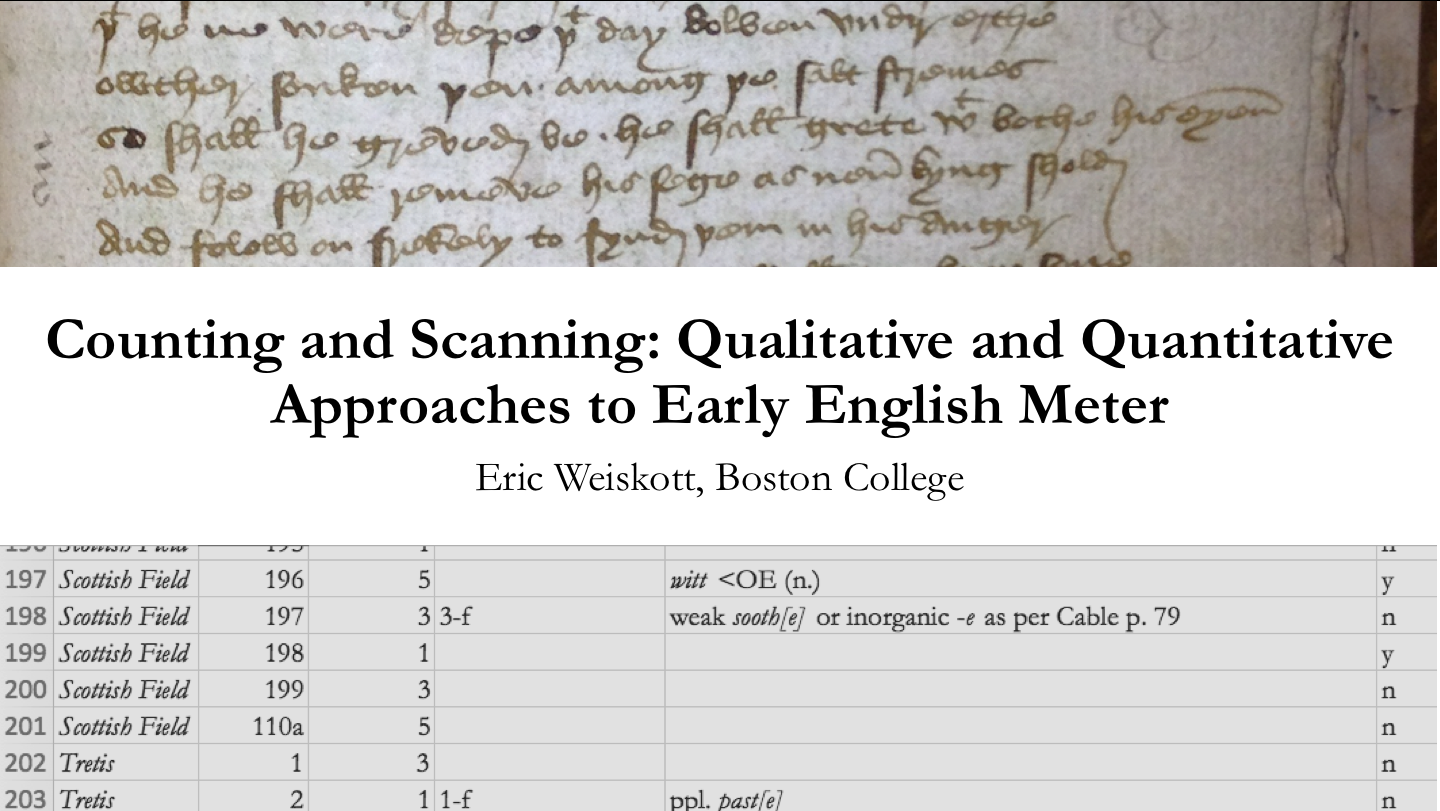
This weekend, I presented a paper at Digital Britain: New Approaches to the Early Middle Ages in Cambridge, MA. My gratitude to Sam Berstler, Joey McMullen, and Erica Weaver for the invitation, and for organizing the conference. My paper, “Counting and Scanning: Qualitative and Quantitative Approaches to Early English Meter,” is an essay in the philosophy of science, focusing on the use of quantitative reasoning in a specialized field of literary study. Here’s the opening frame:

This is a paper in defense of counting in literary studies. It’s also a paper about why counting needs defending in literary studies in 2016. First, I’d like to connect these topics to the conference theme.

The so-called digital turn in academic knowledge production poses a material challenge to the methodological status quo of the humanities. Digital technology makes a bold promise: the quantification of human experience. For constituents of the status quo, the promise of digital technology seems more like a threat. Many humanists worry about what is lost when the richness of culture and the arts is reduced to data. For others, digital tech enables the humanities to live up to their potential. To take an egregious example, Franco Moretti’s ‘distant reading’ does not merely claim to be a good method of reading literature; it claims to be the best method. In promoting statistical approaches to literary history, Moretti taps into philosophical attitudes that predate the digital. His aggressive empiricism is at once the attraction and the scandal of distant reading.

Thus the digital turn irritates a long-standing tension in humanistic study between qualitative and quantitative methods. I propose to explore this tension by focusing on a field of inquiry that bears an unusual relationship to it. Metrics, depending on your perspective, is either the field entrusted with explaining what makes poetry poetry, or the field charged with inferring an organizational system from linguistic patterning. Metrical scholarship combines qualitative and quantitative reasoning in a way that has become uncomfortable in literary studies.

Discomfort with the modus operandi of metrics is acute in the case of early medieval literature, whose systems of formal organization lie at a great cultural remove from those of modern literature. In reconstructing early medieval meters, the value of modern experiences of poetics, and hence the network of assumptions underlying data collection, is always open to question. About the meter of Beowulf, for example, it is currently possible to hold any one of a number of mutually contradictory theoretical views. Moreover, Old English metrical theories cluster in two incommensurable research paradigms, one continuously elaborated since the nineteenth century, the other disclosed for the first time in 2008 (see Cornelius, “The Accentual Paradigm in Early English Metrics”). Metrists disagree, and they disagree about why they disagree. For many literary scholars, meanwhile, metrics is a field that deploys the rhetoric of accumulation to make exaggerated claims on historical truth.

counting and scanning header

In light of these problems, what I’d like to do this morning is to sketch the function of counting in metrics, with reference to my research on English alliterative verse. I have two goals: to affirm the role of quantitative reasoning in literary study, and then to set a certain limit on that role. In what follows, I identify and address two philosophical challenges to counting as a critical method. One challenge comes from the right, framed in the language of neopositivism; the other comes from the left, framed in the language of poststructuralism. I contend that the neopositivist and poststructuralist positions both miss the full significance of counting as a way of getting at “the heart of a poem,” in the words of Simon Jarvis. Ultimately, I’ll argue that metrical study explodes the distinction between qualitative and quantitative approaches to literature.

meter as a way of thinking

Yesterday, I gave an invited talk for the MIT Ancient & Medieval Studies Colloquium Series. My gratitude to Arthur Bahr for the invitation. My talk was entitled “Early English Meter as a Way of Thinking.” Here’s the opening frame of the talk:

This paper is about structures of thought that happen to take the form of poetry. So stated, my object of inquiry would seem to be intellectual history, to which poetics is subordinated. However, I will strive to demonstrate that verse form is never incidental to the thinking it performs. Apprehending meter as a way of thinking necessarily involves reimagining thinking itself.

My title echoes Simon Jarvis, who recommends approaching “prosody as cognition.” Jarvis had Alexander Pope and William Wordsworth in mind when he coined that phrase. I seek to test Jarvis’s concept against a different literary archive, exploring the particular kinds of thinking done by and through early English meter. I’ll focus on the second half of the fourteenth century, a stretch of decades that saw a large uptick in the production of literature in English. As we will see, in medieval England meter was a way of thinking about form and balance, translation and vernacularity, and the historicity of literary practice. I’ll present three case studies introducing three kinds of metrical practice: the half-line structure in Middle English alliterative meter, the interplay between Latin and English in Piers Plowman, and final –e in Chaucer’s pentameter.

The protagonists of the three case studies are the three biggest names in Middle English literature: the Gawain poet, William Langland, and Geoffrey Chaucer. The first of these is no name at all but a cypher: the Gawain poet, thought to have composed the four poems in British Library Cotton Nero MS A.X. For this poet, no external evidence for authorship or biography has been identified. William Langland is little more than a floating name in literary history: mentioned in a few contemporary documents, Langland probably belonged to the well-to-do Rokele family. The name ‘Langland’ itself may be a pseudonym. Chaucer, of course, is the Grand Poobah of medieval English literature. Like Gilbert and Sullivan’s character, Chaucer was chronically overemployed; at one time or another he was a clerk, controller of customs, diplomat, esquire, forester, page, and soldier. These three poets have garnered the lion’s share of scholarly attention, and this paper follows suit by placing them at the center of an essay in historical poetics. But I’ll continually emphasize how the metrical practice of a range of contemporary and prior poets shaped the structures of thought informing Sir Gawain and the Green Knight, Piers Plowman, and the Canterbury Tales.

My broadest aim this afternoon is to convince you that intellectual history and poetics can inform one another. Indeed, where poetry is concerned, the procedures of the two fields ought to coincide. Medievalists have made significant contributions toward understanding poetry as cognition: I’m thinking especially of the work of Ruth Evans, Alastair Minnis, Fiona Somerset, Nicholas Watson, and others under the banner of what Minnis calls “medieval literary theory.” This research program compares the explicit theories of authority and textuality propounded in Latin by medieval scholars with the often implicit theorization of literature performed by vernacular texts themselves. To date, few medievalists have considered the intellectual significance of English meter, though I am indebted to the work of Thomas Cable, a metrist who has always insisted that the study of meter is about “mental structures.” From the perspective of intellectual history, I propose to enrich the study of medieval literary theory by disaggregating the English literary field by metrical tradition. Alliterative meter does not think the same way pentameter thinks; the difference should matter in any account of medieval literary theory. From the perspective of poetics, I propose to redirect the philological procedures of the highly traditionalist field of metrics toward a phenomenological poetics. If meter lives in the mind, then it is part of the job of a metrist to discover what it is doing up there.

phonology and literary history

This past weekend, I presented a paper at the Medieval Academy of America Annual Meeting in Boston. My paper, “Metrical Phonology and Literary History in the Age of Chaucer,” introduces three English metrical traditions–alliterative meter, tetrameter, pentameter–and points to some phonological evidence for cross-pollination between them in the fourteenth century. Here’s the opening frame:

At the end of Book V of Troilus and Criseyde, Chaucer apostrophizes the poem:

And for ther is so gret diversite
In Englissh and in writyng of oure tonge,
So prey I God that non myswrite the,
Ne the mysmetre for defaute of tonge.

(1793-96)

This passage has attracted significant attention as a testament to linguistic, metrical, and textual variation in medieval England. The apostrophe appears to substantiate conclusions that medievalists are ready to accept anyway: that Chaucer’s language, meter, and texts were in flux around him, and that Chaucer was exquisitely aware of this situation. In the standard interpretation, the speaker of the passage is a lot like a modern editor, worried about language change, metrical decay, and scribal error.

In this paper I’d like to suggest a different cultural context for Chaucer’s hand-wringing: the mediated interaction between language and meter in fourteenth-century English verse. ‘Metrical phonology’ is my term for the linguistic forms that meter encodes. Think, for example, of the variation between monosyllabic and disyllabic scansions of the word heaven in Elizabethan poetry. I will argue that metrical phonology should be understood in terms of the larger historical formation in which it is embedded: the poetic tradition. In the fourteenth century, there were three major metrical options for poets working in English: the alliterative meter, the tetrameter, and the pentameter. The alliterative meter had been in continuous use since at least the eighth century. The tetrameter entered the English literary field in the mid thirteenth century. Chaucer invented the pentameter on the basis of French and Italian models in the 1380s: Troilus and Criseyde is his first substantial work in this new verse form. The three major Middle English meters thus had different histories. Yet these histories also inflected one another. Study of metrical phonology calls for triangulation between historical and comparative analysis. That’s what I’ll try to provide.

By mapping Middle English metrical phonologies, it becomes possible to attain some critical distance from the Troilus and Criseyde passage. Through apostrophe, Chaucer hints at the complexity of fourteenth-century vernacular poetics. However, writing before English became an academic subject, Chaucer necessarily expresses his position in literary culture symptomatically rather than analytically. Attention to the historicity of metrical phonology helps us understand what Chaucer meant by the neologism ‘mismeter’ but also how meter could appear to Chaucer as a poetic problem in the first place.