Calabrese, Introduction to “Piers Plowman”

My review of Michael Calabrese, An Introduction to “Piers Plowman” (Gainesville: University Press of Florida, 2016), appears in the Journal of English and Germanic Philology. Here’s the opening of the review:

The alliterative poem Piers Plowman survives in three distinct versions (‘A,’ ‘B,’ and ‘C’), composed in the 1370s and 1380s by one William Langland. The A version consists of a prologue and eleven ‘passūs’ or sections; B extends A to twenty passūs; and C reorganizes B into twenty-two passūs. The B text has received the most attention from literary scholars and is most often taught to students. James Simpson’s Piers Plowman: An Introduction (Exeter, 1990; rev. ed. 2007) and Emily Steiner’s Reading “Piers Plowman” (Cambridge, 2013) both focus on B, with glances at A and C.

The book under review is the first introduction to devote equal attention to all three versions. Michael Calabrese presents an integrated, passus-by-passus summary of Piers Plowman A, B, and C in twenty-four short sections (“Narrative Reading Guide”). Exposition begins from the earliest version for each passus, with generous discussion of insertions, deletions, and revisions in later versions. Surrounding the reading guide is a variety of supplemental material: a preface advocating the study of Piers Plowman in contemporary America; a chronology of significant people and events; essays on Langland’s biography and political contexts (“Life of the Poet”) and the relationship between Piers Plowman and other canonical medieval literature (“Langland and His Contemporaries”); an appendix listing characters or actants in the poem (“Persons, Personifications, and Allegorizings in Piers Plowman”); an appendix introducing Middle English pronunciation and alliterative meter (“Pronunciation Guide: Reading Piers Plowman Aloud”); and a partially annotated bibliography.

The preface makes a strong case for the urgency of Piers Plowman in the twenty-first century. […]

counting and scanning

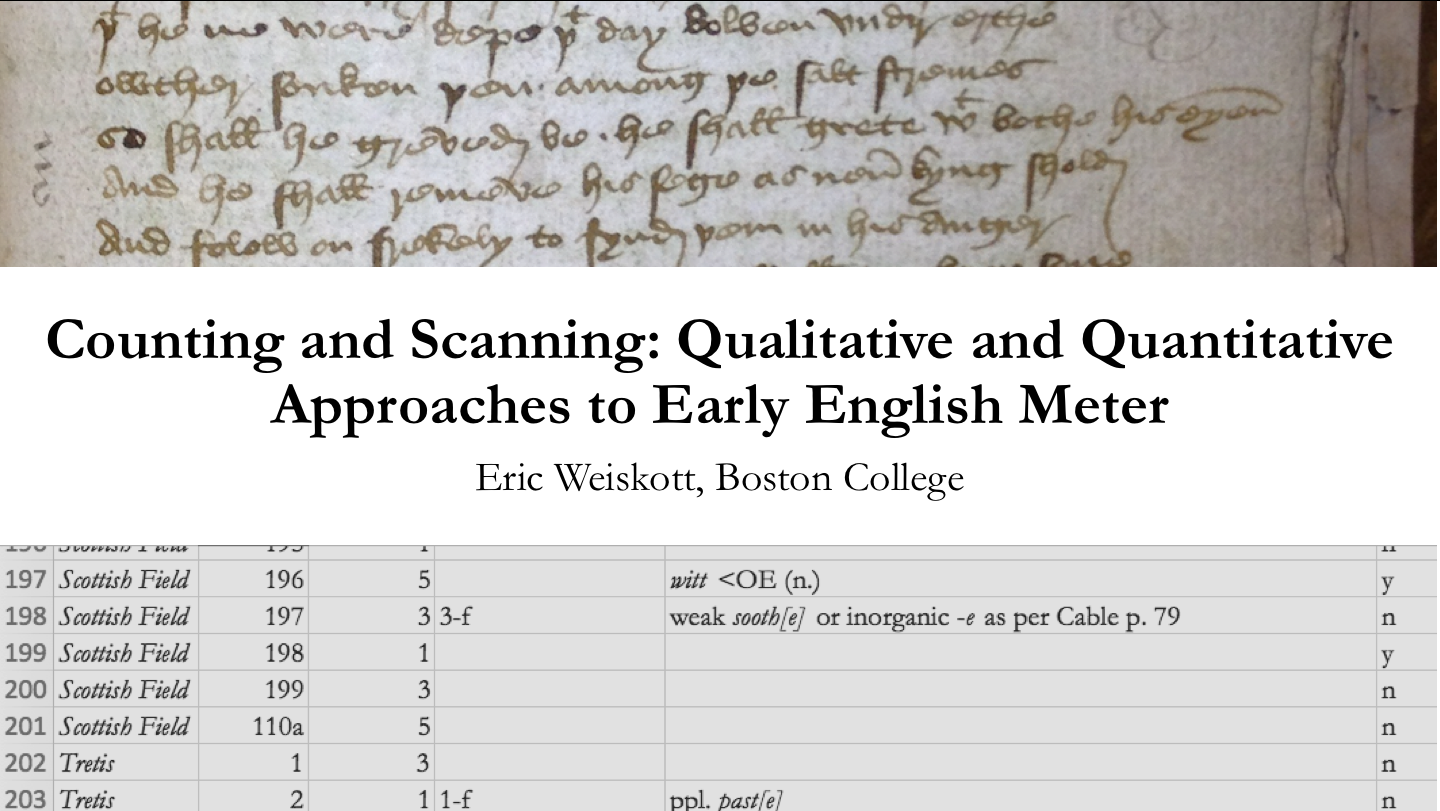
This weekend, I presented a paper at Digital Britain: New Approaches to the Early Middle Ages in Cambridge, MA. My gratitude to Sam Berstler, Joey McMullen, and Erica Weaver for the invitation, and for organizing the conference. My paper, “Counting and Scanning: Qualitative and Quantitative Approaches to Early English Meter,” is an essay in the philosophy of science, focusing on the use of quantitative reasoning in a specialized field of literary study. Here’s the opening frame:

This is a paper in defense of counting in literary studies. It’s also a paper about why counting needs defending in literary studies in 2016. First, I’d like to connect these topics to the conference theme.

The so-called digital turn in academic knowledge production poses a material challenge to the methodological status quo of the humanities. Digital technology makes a bold promise: the quantification of human experience. For constituents of the status quo, the promise of digital technology seems more like a threat. Many humanists worry about what is lost when the richness of culture and the arts is reduced to data. For others, digital tech enables the humanities to live up to their potential. To take an egregious example, Franco Moretti’s ‘distant reading’ does not merely claim to be a good method of reading literature; it claims to be the best method. In promoting statistical approaches to literary history, Moretti taps into philosophical attitudes that predate the digital. His aggressive empiricism is at once the attraction and the scandal of distant reading.

Thus the digital turn irritates a long-standing tension in humanistic study between qualitative and quantitative methods. I propose to explore this tension by focusing on a field of inquiry that bears an unusual relationship to it. Metrics, depending on your perspective, is either the field entrusted with explaining what makes poetry poetry, or the field charged with inferring an organizational system from linguistic patterning. Metrical scholarship combines qualitative and quantitative reasoning in a way that has become uncomfortable in literary studies.

Discomfort with the modus operandi of metrics is acute in the case of early medieval literature, whose systems of formal organization lie at a great cultural remove from those of modern literature. In reconstructing early medieval meters, the value of modern experiences of poetics, and hence the network of assumptions underlying data collection, is always open to question. About the meter of Beowulf, for example, it is currently possible to hold any one of a number of mutually contradictory theoretical views. Moreover, Old English metrical theories cluster in two incommensurable research paradigms, one continuously elaborated since the nineteenth century, the other disclosed for the first time in 2008 (see Cornelius, “The Accentual Paradigm in Early English Metrics”). Metrists disagree, and they disagree about why they disagree. For many literary scholars, meanwhile, metrics is a field that deploys the rhetoric of accumulation to make exaggerated claims on historical truth.

counting and scanning header

In light of these problems, what I’d like to do this morning is to sketch the function of counting in metrics, with reference to my research on English alliterative verse. I have two goals: to affirm the role of quantitative reasoning in literary study, and then to set a certain limit on that role. In what follows, I identify and address two philosophical challenges to counting as a critical method. One challenge comes from the right, framed in the language of neopositivism; the other comes from the left, framed in the language of poststructuralism. I contend that the neopositivist and poststructuralist positions both miss the full significance of counting as a way of getting at “the heart of a poem,” in the words of Simon Jarvis. Ultimately, I’ll argue that metrical study explodes the distinction between qualitative and quantitative approaches to literature.

Stanford visit

Eric Weiskott at Stanford

photo credit: Elaine Treharne

This past week, I visited Stanford University as a Text Technologies Fellow. While at Stanford I also spoke to the Workshop in Poetics, recorded a video interview for a developing digital resource for the study of prosody, and guest-lectured on early English alliterative meter in English 301B, Love and Loss in Early English, 900-1300. My gratitude to Elaine TreharneArmen DavoudianRoland GreeneNick Jenkins, and Mary Kim for these invitations and to Armen, Mary, and Daeyeong (Dan) Kim for making local arrangements. Here is a summary of my visit on Stanford’s website.

As a Text Technologies Fellow, I gave a lecture to the Stanford CMEMS Workshop entitled “The Old English Exeter Book and the Idea of a Poem.” This lecture represents new thinking at the nexus of poetic meter, manuscript form, and the history of ideas. My thanks to the attendees for helpful questions and criticisms. Here’s a modified version of the opening frame of the talk:

As a visitor to the Workshop in Poetics, I presented a work in progress entitled “Before Prosody: Early English Poetics in Practice and Theory.” This essay relates the conclusions of my first book to the emergent research paradigm known as ‘historical poetics.’ My thanks to the members of the Workshop for incisive questions and comments. Here’s an abstract:

Scholars of Victorian poetry have called for a ‘historical poetics’ that would reevaluate the received narrative of English literary history by recovering alternate ways of theorizing and experiencing poetic form. This essay takes a longer view onto the histories of English poetry from the perspective of Old English and Middle English verse. The primary purpose of the essay is to offer medieval English poetry as a case in point for historical poetics, thereby bringing a different literary archive to bear on critical conversations about the theory and practice of English versification. The contribution of this essay to the field of historical poetics will be to indicate a constitutive gap between the practice and theory of verse. Through three case studies drawn from ongoing research on the alliterative tradition, I seek to demonstrate what is distinctive about the cultural work of early English poetics. Recognition of the ways in which modern questions fail to illuminate medieval meters is the first step toward a more capacious historical poetics.

As a contributor to a developing digital resource for the study of prosody, I discussed alliteration as a poetic device and an ornament in alliterative meter; the alliterative tradition, Old to Middle English; and the state of the field of alliterative metrics.

As a guest lecturer in English 301B, I taught a class of undergraduates and graduate students about the history of the alliterative metrical system c. 900-1200, with examples drawn from the Battle of Brunanburh (c. 937), Durham (1104-1109), and Lawman’s Brut (c. 1200). We asked how this metrical system stood around 900, how it changed between then and 1200, and how modern scholars have conceptualized these metrical principles and transformations. It was exciting to be able to help the students connect meter with the primary concerns of the seminar: linguistic form, literary style, periodization, and manuscript context.

a companion website

Through a generous grant from Boston College’s Academic Technology Advisory Board, I have received funding to use the MediaKron digital toolkit to build a companion website for my undergraduate course, Middle English Alliterative Poetry. An in-progress version of the site is publicly available here. The site currently features a short guide to Middle English pronunciation, with sound clips; a short guide to Middle English alliterative meter, with bibliography; a short guide to medieval English codicology and paleography, with annotated manuscript images and bibliography; and a timeline of poems and significant historical events, with short descriptions and bibliographies. Through collaboration with my students, the site will eventually feature an introduction to each course text, with annotated manuscript images and bibliographies. Here’s the course description, which also appears on the landing page of the website:

In the fourteenth century, there were two ways of writing poetry in English. Chaucer’s rhyming, syllable-counting iambic pentameter exemplifies one tradition. This course makes a survey of the other tradition, known today as alliterative poetry. Among the poems we will read are tales of King Arthur’s court, the story of a resurrected corpse discovered in London, and a wild allegorical dream-vision starring such characters as Bribery and Truth. We ask how this poetry is formally organized, where this form of writing comes from, and why medieval English writers chose to use it. No prior knowledge of Middle English required.

real formalism, real historicism

I presented a short paper at the MLA in Vancouver, in a roundtable session entitled “‘Real’ Old English?” Thanks to the MLA Old English Division Committee for the invitation. I reproduce the paper in full here:

In the next seven minutes, I would like to convince you that real formalism and real historicism really are, or really should be, one and the same critical practice. Our idea of what counts as knowledge about early English literature will be enriched by integrating formalist and historicist methods. Those of us who work on prosody and poetics are used to being admonished that formalism needs to be historicist. I agree. But I am equally interested in affirming that historicism needs to be formalist.

Here are two concrete examples of the opportunity for methodological integration, drawn from my research on the alliterative tradition. First, the most famous theory of Old English meter, Sievers’s Five Types, is an ahistorical formalism. It prescribes the same metrical norms for Cædmon’s Hymn in the seventh century as for the Death of Edward in the eleventh. What is worse, Sievers based his theory on Beowulf, an undated and possibly idiosyncratic poem. Geoffrey Russom’s word-foot theory and Nicolay Yakovlev’s morphological theory each represent an improvement on Sievers in that they each allow for metrical change over time.

Second, the marginalization of eleventh-, twelfth-, and thirteenth-century English texts reflects an Old Historicism that sought to align literary history and political history. The Normans conquered England, and English literature began to decay—or so the thinking goes. More recent scholarship problematizes this reductive view by emphasizing the dynamism and continuity of literary forms across the artifactual boundary of 1066. Indeed, this emergent research paradigm has begun to suggest the incoherence of the received period terms ‘Old English’ and ‘Middle English’ as such. The forms of literature explored by newer scholarship are material and intellectual (as in Elaine Treharne‘s work on twelfth-century habits of reading and transcription) but also linguistic and metrical (as in Yakovlev’s dynamic theory of the meter of Lawman’s Brut, which he also directly connects to his theory of Old English meter). In these and many other ways, historicizing literary form and formalizing literary history are complementary and interrelated research priorities.

For Old English to be real or really important, these large ideas and specialist debates must also work their way down into our pedagogy. Our undergraduate students want formalism, need historicism, and deserve both. As their first (and likely their only) teachers of Old English, it behooves us to introduce current understandings of literary form, while highlighting the problem of historical difference. Ideally, as I have been suggesting, these priorities coincide. I tend to initiate classroom discussions with prompts like, “Imagine a time before the invention of rhyming English meters,” or “Now that we have moved from the tenth century to the twelfth, which forms of language or literature seem different, and which seem the same?” This approach signals to students that the appreciation of literature as literature and the exploration of literary history as history are not somehow separate endeavors. This is, I submit, one of the most profound lessons we can impart to students who may be passing through our seminars to fulfill historical requirements within the English major. Our students will get the most out of Old English when they can encounter literary form as a historical phenomenon and understand literary history as an accretion of forms and styles. Form as history: history as form.

I have already indicated how recent work from within our field is pushing the field’s overdetermined historical boundaries, reconnecting ‘Old English’ with later forms of English language and literature. By way of conclusion, I’d like to discuss one way in which we might use the conjunction of form and history to enter into a meaningful conversation with our colleagues in later periods. The emerging field of ‘historical poetics’ proposes to historicize meters and discourses of the literary in order to reconfigure literary history. Currently, historical poetics is most strongly associated with the study of eighteenth- and nineteenth-century British poetry, as in the work of Simon Jarvis and Yopie Prins. Engagement with the methodology of historical poetics on the part of Old English specialists would, I think, be mutually beneficial. The modernists have much to teach us about the microstructure of literary history; and we have much to teach them about the longer genealogies of form that connect early English literature to the complex literary cultures of the eighteenth and nineteenth centuries. Moreover, medievalists are uniquely positioned to analyze the differences between practice and theorization of literary form, since medieval authors, in contrast to modern ones, practiced literary form at a time when vernacular poetics had not yet become an academic subject or a sustained cultural discourse. Many of us are already engaged in research that historicizes form and formalizes history. Again, unlike our modernist colleagues, we have never had the luxury of taking for granted the material, intellectual, linguistic, or metrical contexts of the literature we study. Historical poetics presents an opportunity for us to articulate the value of our field to English studies as a whole.

I have also deposited the paper in MLA CORE.