a postdating of throw ‘time’

My note, “A Postdating of Throw ‘Time’ in Twelfth Night,” appears in Notes and Queries. It’s expected to be published in fall 2016. This note identifies the latest known instance of throw in the sense ‘time,’ in Shakespeare’s early seventeenth-century play. I teach Twelfth Night in Literature Core, and I noticed that editors of the play do not consistently catch Orsino’s pun on the word throw in Act 5. This prompted me to consult the Oxford English Dictionary, where throw ‘time’ was said to have disappeared in the early sixteenth century. Here’s an abbreviated version of the opening paragraph of the note:

In the final act of Shakespeare’s Twelfth Night (1600-01), Duke Orsino rebuffs Feste’s third request for payment: ‘You can fool no more money out of me at this throw’ (V.i.32). The primary meaning of throw is ‘time’, from Old English þrag ‘time; season’. The secondary meaning is ‘throw (of the dice)’, playing on Feste’s dice metaphor (‘Primo, secundo, tertio is a good play’, V.i.29). This occurrence of throw ‘time’ postdates by almost a century the last citation for that meaning at Oxford English Dictionary Online, ‘throw, n.1, 1 (‘The time at which anything happens; an occasion’), from Gavin Douglas’s Eneados (1513).

meter as a way of thinking

Yesterday, I gave an invited talk for the MIT Ancient & Medieval Studies Colloquium Series. My gratitude to Arthur Bahr for the invitation. My talk was entitled “Early English Meter as a Way of Thinking.” Here’s the opening frame of the talk:

This paper is about structures of thought that happen to take the form of poetry. So stated, my object of inquiry would seem to be intellectual history, to which poetics is subordinated. However, I will strive to demonstrate that verse form is never incidental to the thinking it performs. Apprehending meter as a way of thinking necessarily involves reimagining thinking itself.

My title echoes Simon Jarvis, who recommends approaching “prosody as cognition.” Jarvis had Alexander Pope and William Wordsworth in mind when he coined that phrase. I seek to test Jarvis’s concept against a different literary archive, exploring the particular kinds of thinking done by and through early English meter. I’ll focus on the second half of the fourteenth century, a stretch of decades that saw a large uptick in the production of literature in English. As we will see, in medieval England meter was a way of thinking about form and balance, translation and vernacularity, and the historicity of literary practice. I’ll present three case studies introducing three kinds of metrical practice: the half-line structure in Middle English alliterative meter, the interplay between Latin and English in Piers Plowman, and final –e in Chaucer’s pentameter.

The protagonists of the three case studies are the three biggest names in Middle English literature: the Gawain poet, William Langland, and Geoffrey Chaucer. The first of these is no name at all but a cypher: the Gawain poet, thought to have composed the four poems in British Library Cotton Nero MS A.X. For this poet, no external evidence for authorship or biography has been identified. William Langland is little more than a floating name in literary history: mentioned in a few contemporary documents, Langland probably belonged to the well-to-do Rokele family. The name ‘Langland’ itself may be a pseudonym. Chaucer, of course, is the Grand Poobah of medieval English literature. Like Gilbert and Sullivan’s character, Chaucer was chronically overemployed; at one time or another he was a clerk, controller of customs, diplomat, esquire, forester, page, and soldier. These three poets have garnered the lion’s share of scholarly attention, and this paper follows suit by placing them at the center of an essay in historical poetics. But I’ll continually emphasize how the metrical practice of a range of contemporary and prior poets shaped the structures of thought informing Sir Gawain and the Green Knight, Piers Plowman, and the Canterbury Tales.

My broadest aim this afternoon is to convince you that intellectual history and poetics can inform one another. Indeed, where poetry is concerned, the procedures of the two fields ought to coincide. Medievalists have made significant contributions toward understanding poetry as cognition: I’m thinking especially of the work of Ruth Evans, Alastair Minnis, Fiona Somerset, Nicholas Watson, and others under the banner of what Minnis calls “medieval literary theory.” This research program compares the explicit theories of authority and textuality propounded in Latin by medieval scholars with the often implicit theorization of literature performed by vernacular texts themselves. To date, few medievalists have considered the intellectual significance of English meter, though I am indebted to the work of Thomas Cable, a metrist who has always insisted that the study of meter is about “mental structures.” From the perspective of intellectual history, I propose to enrich the study of medieval literary theory by disaggregating the English literary field by metrical tradition. Alliterative meter does not think the same way pentameter thinks; the difference should matter in any account of medieval literary theory. From the perspective of poetics, I propose to redirect the philological procedures of the highly traditionalist field of metrics toward a phenomenological poetics. If meter lives in the mind, then it is part of the job of a metrist to discover what it is doing up there.
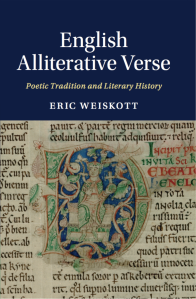
tradition and literary history

My first book, English Alliterative Verse: Poetic Tradition and Literary History, is published by Cambridge University Press (2016).

Eric Weiskott, English Alliterative Verse: Poetic Tradition and Literary History

English Alliterative Verse tells the story of the medieval poetic tradition that includes Beowulf, Piers Plowman, and Sir Gawain and the Green Knight, stretching from the eighth century, when English poetry first appeared in manuscripts, to the sixteenth century, when alliterative poetry ceased to be composed. The book draws on the study of meter to challenge the traditional division of medieval English literary history into ‘Old English’ and ‘Middle English’ periods. The two halves of the alliterative tradition, divided by the Norman Conquest of 1066, have been studied separately since the nineteenth century; this book uses the history of metrical form and its cultural meanings to bring the two halves back together. In combining literary history and metrical description into a new kind of history called ‘verse history,’ English Alliterative Verse reimagines the historical study of poetics.

Individual chapters consider (1) Beowulf; (2) prologues to Old English poetry; (3) Lawman’s Brut, an alliterative verse chronicle of the twelfth century; (4) prologues to Middle English poetry; (5) St. Erkenwald, an alliterative romance of the fourteenth or fifteenth century; and (6) the alliterative tradition in the sixteenth century.

A version of Chapter 3 appears in an edited volume devoted to Lawman’s Brut. I have also edited two late fifteenth-century alliterative poems, The Ireland Prophecy (Studies in Philology) and The Vision of William Banastre (in an edited volume devoted to early English poetics), and I have brought to light two sixteenth-century excerpts from Piers Plowman (Review of English Studies). These new texts inform the arguments of Chapter 6. Four articles bring the arguments and methods of the book to related topics: the relationship between metrical history and language history (Modern Philology); the meter of Piers Plowman (Yearbook of Langland Studies); the history of modern scholarship on medieval verse (ELH); and the historical study of poetics (Modern Language Quarterly).

phenomenological poetics

I’d like to use this post to introduce a general methodological approach in the field of poetics. Much of my work on early English poetry thus far has been concerned to analyze poetic features not as objective linguistic structures but as mental events. Meter as a mental event; syntax as a mental event; wordplay as a mental event. This general approach to poetics might be termed ‘phenomenological poetics.’*

In pursuing phenomenological poetics, I find myself producing scholarly work that cuts across the structuralism/poststructuralism and formalism/historicism dichotomies. On the one hand, phenomenological poetics differs from most strands of structuralism in refusing to externalize form. For example, my article on Old English poetic syntax mounts a historicist argument against modern editors who propose to chop poetic texts into modern sentences. I argue that certain kinds of syntactical complications are stylistic effects purposefully offered to medieval minds, not syntactical problems accidentally offered to modern textual criticism. To make this argument, however, I build on the findings of modern linguistics and the study of syntax: it’s an argument about the history of form that recognizes form but tries hard not to reify form.

On the other hand, phenomenological poetics operates differently from most strands of poststructuralism, too. For example, my first book tracks the history of the English alliterative meter from the seventh to the sixteenth century. Where poststructuralists often express skepticism about the reality of meter as an object of inquiry, I discuss meter as a real mental event. I consider my work to be materialist, with the understanding that the materials are not pronunciations, spellings, syllables, or even metrical notations but forms of expectation and perception. Meter, for me, lives in the mind, but it lives in the mind in formally and historically specifiable ways. My book argues, in part, that we should not allow that formal and historical nuance to be flattened out by skepticism about our ability to capture it. In phenomenological poetics, questions about literary form and questions about literary history simply coincide, inasmuch as recovering medieval thought processes about poetry is an inherently formal and historical task.

In describing my approach as materialist but concerned with mental processes, I am, of course, coming close to the interdisciplinary field known as cognitive poetics. The cognitive sciences are those dealing with the material that grounds the mental. Thus far I have not connected my research in poetics with the cognitive sciences, but I have learned a great deal from metrists who have: Nick Myklebust, for example.

*A quick Google search reveals that others have used the phrase in a different sense, to refer to poetry that itself engages phenomenological philosophy or phenomenological experience.

verse by verse

My article, “Old English Poetry, Verse by Verse,” appears in Anglo-Saxon England. Here’s the abstract:

Certain syntactical ambiguities in Old English poetry have been the focus of debate among students of metre and syntax. Proponents of intentional ambiguity must demonstrate that the passages in question exhibit, not an absence of syntactical clarity, but a presence of syntactical ambiguity. This article attempts such a demonstration. It does so by shifting the terms of the debate, from clauses to verses and from a spatial to a temporal understanding of syntax. The article proposes a new interpretation of many problematic passages that opens onto a new way of parsing and punctuating Old English poetry.

In this essay in the history of poetic style, I demonstrate that the sequence in time of Old English half-lines sometimes necessitates retrospective syntactical reanalysis, a state of affairs which modern punctuation is ill-equipped to capture, but in which Anglo-Saxon readers and listeners would have recognized specific literary effects. In the second section, I extrapolate two larger syntactical units, the half-line sequence and the verse paragraph, which differ in important ways from the clauses and sentences that modern editors impose on Old English poetic texts. Along the way, I improve the descriptive accuracy of Kuhn’s Laws by reinterpreting them as governing half-line sequences rather than clauses. I conclude with a call for unpunctuated or minimally punctuated critical editions of Old English verse texts.