Piers Plowman / social upheaval

William Langland’s Piers Plowman (composed 1370s-1380s) is a poem of social upheaval. It grapples with new social realities in the wake of the plague, which devastated England in 1348; its title character became a codename in an uprising of peasants, laborers, and artisans in 1381; fictionally, it depicts a society on the brink of implosion.

The 1381 connection has, rightly, attracted a lot of attention from Langland’s modern readers (Justice). During the uprising, rebels beheaded government officials, burned legal documents, and exchanged letters calling on Piers the Plowman to “go to his work.” To adapt a phrase that Lerner uses to characterize the ideology of the avant-garde, Piers Plowman was “an imaginary bomb with real shrapnel” (39). There are not many poems that come with a death toll–and none that I can think of that are such good poetry.

Piers Plowman is a poem of social upheaval in another sense, and here I’m moving from critical commonplaces to a new argument that I make in a forthcoming article. Langland’s poem takes the form of a search for truth and justice in this world, including social justice, but a search that is known ahead of time to be an abject failure. Why? Here Langland would spread his hands theatrically wide. The wretchedness of the world was, for him, self-evident. A truth that Piers Plowman repeatedly discovers is this: perversely, describing a better world drives home how awful this one, the actual one, is. Langland expresses this truth by obsessively hitting the poetic reset button that was available to him in the dream vision form (first-person dreamer falls asleep in springtime, has a disorienting allegorical vision of dubious significance, etc.). Other medieval dream visions are one long dream; the dreamer of Piers Plowman is always falling back asleep.

In the article, I write:

Piers Plowman deepens or intensifies but does not progress. It is a tensile poem, responsive to the world, but it does not move, really. Running in parallel with the successive invocation and dismissal of [literary] genres, Piers Plowman proposes extrainstitutional principles for the refoundation of Christian society, all of which fail in precisely the same way, by generating the unacceptable present reality. This is Langland’s “negative utopianism,” as identified by Karma Lochrie [164]. […] The whole poem expands and expounds the opening dream of a society gripped by debilitating hypocrisy.

(In making this argument I join one strand of modern commentary on Piers Plowman, which sees its structure as basically recursive, like a Möbius strip [Middleton]. There is another strand that views its structure as basically progressive, like a pilgrimage. This scholarly schism is fascinating in its own right and tells you a lot about the poem.)

My article defines Piers Plowman‘s recursive form and proposes a new analog for it, the tradition of political prophecy (think Merlin). But there is maybe more to say about the political implications of literary recursivity and failure. Lerner again: “‘Poetry’ is a word for a kind of value no particular poem can realize: the value of persons, the value of a human activity beyond the labor/leisure divide, a value before or beyond price” (53). Langland felt that. Piers Plowman is a massive failure, and knows it. It is a theological failure; it is a political failure; it is a social failure; and it is therefore a poetic failure. It has to be: it is a “particular poem,” not a sublime abstraction. Piers Plowman includes asides in which the narrator/poet Will is berated by a range of allegorical figures–Reason; Conscience; even imagination, who might be expected to be a fan–for wasting time writing all that dumb poetry.

Piers Plowman‘s circuit of frustration and failure conforms to some modern political and social problems. The sterile debate about whether everything or nothing in society nowadays is neoliberal, and, interlocking that debate, the sniping at and among the various strands of socialism share a structure that will be familiar to a reader of Langland. The problem of a term meant to encompass an entire mode of social organization, like feudal or neoliberal, might be that it is being pressed to do too much conceptual work; or it might be that it is too apt, that a mode of social organization is at that moment oppressively total (Song).* Correspondingly, the problem with political labels/ideologies like socialism–but equally small-l liberalism, and fascism–might be that their political content is inimical to a given person’s disposition, experience, and social placement; or it might be that the distance between the world as it is and the ideal state of affairs that those terms differently demand is insufferable. We are all familiar with how fruitless it is to argue against one of the isms armed only with an actual example. It is always possible, and in practice easy, to exclude the example from the ideal. Socialists, liberals, and fascists all do this: actually existing inequity can only ever be blamed on someone else’s abstraction. To an extent, this is understandable. One’s political ideals are ideals precisely insofar as they’ve never been put into practice. Nothing will wreck the beautiful poem in your head faster than trying to write it down.

This two-sided discursive problem–a political description that seems uselessly repetitious with the totality of lived experience, and one that seems uselessly abstract and unattainable–maps onto what I see as the major poles of Langland’s vacillating thought throughout the poem. It’s not as if there is for Langland a middle ground, where terms are just useful enough. It’s failure all the way down: either a failure to imagine anything different, or else a failure to imagine anything achievable. Piers Plowman expresses its optimism that things could change for the better in a fashion that would seem strangely pessimistic if it were not also the signature move of academic ideology critique: to demolish, one by one, ideas that won’t work.

But social upheaval does occur. We know this. Langland knew this, too. Piers Plowman alludes more than once to the time “before the plague,” a period represented in the poem as obviously better than the present but sealed off from it by the cataclysm of 1348. The political and social realities which vexed Langland in the 1370s, in turn, gave way to something else. And our unacceptable present reality, whether neoliberal is a perfect or an inane descriptor for it, will end, too. Song on 2010s neoliberalism could be Langland on a post-Edenic world and post-plague England: “a kind of postlapsarian moment that exists ever in the shadow of a time before” (283). Langland did not expect or want his poem to inspire a rebellion, but it did anyway. There seems to be an inevitable asymmetry, a slippage, between the experience of one political/social moment and the remediation of texts and ideas from that moment. Maybe we can just call this slippage (literary) history. It’s something that will continue to fascinate me; and it holds out hope for achieving some measure of justice in a world that is often intolerable. At the same time, it suggests that Langland was right to sense that a poem, no matter how brilliant, would not cut it. “A kind of value no particular poem can realize. . .” A devastating critique of the status quo does not normally change things. It can only be a starting point.


*Hugo Raine has a splendid essay for Verso’s blog on “Marxism and the Middle Ages,” in which he argues that a fundamental error of some Marxist medieval historians is to assume, with Marx, that the totalizing structure of modern capitalism implies prior totalizing modes of economic/social organization. (Hence feudalism.) What if there weren’t any? What if capitalism is in this respect unique? It’s a very smart thought, and I think that in general I agree with it. But Langland does seem to represent the economic/social system of fourteenth-century England as totalized, as implicated in every sector of human existence, even if feudal isn’t the right word for it.

further reading

Justice, Steven. Writing and Rebellion: England in 1381. Berkeley: University of California Press, 1988.

Lerner, Ben. The Hatred of Poetry. New York: Farrar, Straus, & Giroux, 2016.

Lochrie, Karma. Nowhere in the Middle Ages. Philadelphia: University of Pennsylvania Press, 2016.

Middleton, Anne. “Narration and the Invention of Experience: Episodic Form in Piers Plowman.” In The Wisdom of Poetry: Essays in Early English Literature in Honor of Mortwon W. Bloomfield, ed. Larry D. Benson and Siegfried Wenzel (Kalamazoo, MI: Medieval Institute, 1982), pp. 91-122.

Song, Min Hyoung. “An Ethics of Generosity.” In Flashpoints for Asian American Studies, ed. Cathy J. Schlund-Vials (New York: Fordham University Press, 2017), pp. 281-98.

Weiskott, Eric. “Political Prophecy and the Form of Piers Plowman.” Viator (forthcoming).
in defense of metrics

In my forthcoming book Meter and Modernity in English Verse, I begin by defending metrics, the study of poetic meter, a.k.a. prosody. As you probably know if you read this blog, meter is my thing. Metrics needs defending not just because it is a contentious and technical subject, but because it has come in for wounding criticism lately.

I’ll ventriloquize the case against metrics, to avoid naming names. (I do name names in the book.) Metrics, say its critics, is a faux science. It is fruitlessly technical. What do metrists have to show for all those graphs, statistics, symbols, and Greek terms? A relic of Victorian philology, metrics can’t create the knowledge about poetry that it claims to create. It is of historical interest, like alchemy, but it is not worth the paper it is printed on. A sure sign that metrics is a bunch of hot air is the fact that metrists can’t even agree on the basics, such as the nature of stress, the proper placement of accents in a line of poetry, and where poetic forms come from. Each generation’s terminology becomes unintelligible to the next.

This critique sometimes extends to a second target. Meter, the object that metrics purports to disclose, can’t matter in literary studies nowadays. It is a fantasy. The historical stability and formal knowability of meter, implied by techniques of metrical analysis, are illusory. Worse, meter is an illusion that distracts us from what really matters: the political and social meaning of poetry.

I had to respond to these criticisms, because the goal of my book was to build metrical history into a new account of English literary history. If meter had no value, my book had no value!

My basic response is to point out a self-contradiction. The anti-metrists must posit a type of impossible, transcendental knowledge, in order to criticize metrics for not creating it. They choose to judge metrical scholarship against a standard that does not apply to other methodologies, as if metrics, to be legitimate, had to be an infallible truth discovery mechanism, instead of, say, an informed approximation of what poets do. In the book, I write:

To reject metrics as a fantasy of absolute, dehistoricized knowledge is to accede, per negativum, to that fantasy. Metrics is indeed historically contingent, inherently political, and prone to self-confirmation. In this, metrics resembles all other approaches to the study of literature. The choice between affirmation of metrics and acceptance of the limits of historical interpretation is a false one. Metrical form is indeed a literary correlate of politics and ideology. Precisely because it lives in history, however, it refracts as much as it reflects. Poets never make metrical choices in a vacuum. Metrical histories pressurize individual moments of creation and reception, just as political histories pressurize individual moments of action and affiliation. Ideally, metrics accomplishes the very dialectical movement between general and particular, form and history, literary practice and social stratification, that its critics accuse it of short-circuiting.

Criticism of metrics can be so pointed only because few scholars “do” metrics anymore. It’s easy to dismiss a type of knowledge you don’t seek. Plus, meter is still regularly taught to undergraduates, yet the metrical theory in use in the classroom is a century out of date. The lag between textbooks and scholarship leaves the subject all the more vulnerable to criticism.

Lest this sound like the usual complaint that everyone should devote themselves to my hobbyhorse topic, I’ll say (and I say in the book) that metrists are equally to blame. The critics have a point. Metrists bandy about terms that are opaque to other literary scholars; they sometimes appear to promise scientific knowledge about literature; and they often do not explore meter’s intersections with political and social history. In rehabilitating metrics for literary history, my book strives to do better in each respect. The result is, I hope, a metrically inflected literary history that both metrists and anti-metrists can understand, and accept.

politics as prophecy

to understand why political discourse today is so furious, look to medieval England

Last week, the House of Representatives passed a resolution formalizing the impeachment inquiry into President Trump. With this vote, the political situation would appear to inch closer to the result that liberals have been expectantly predicting since 2016.

There’s more than a little anxiety about defeat baked into liberals’ expectations of victory. From the prospect of Brexit to climate catastrophe, from Elizabeth Warren’s “I Have A Plan For That” to Trump’s “Make America Great Again,” predictions about the future are the bread and butter of political discourse. They are more than campaign promises, wishful thinking, or a scientific consensus, though they are these things, too. Like predictions of the apocalypse in various religious traditions, political predictions instill the sense of a common cause, galvanizing believers to agitate for the future they demand. Thinking of politics today as a form of prophecy clarifies why political dialogue can be so furious—and so impervious to fact-checking. It also means politics today is not as different as we might wish from politics in the European Middle Ages, when a more overt type of prophecy energized political action.

In pre-Enlightenment Britain, this political prophecy was associated with a particular strand of history writing, the one whose cast of characters included King Arthur and Merlin. Merlin was, among other things, a prophet. People took very seriously the obscure “prophecies of Merlin,” which represented political and ethnic conflict between the English and the Welsh in terms of dragons, lightning bolts, and rivers of blood. From the Wars of the Roses to the English Revolution, people experienced contemporary political developments through the prism of a vast and complicated future imaginary. You can read the binding real-world force of prophecy in any number of historical episodes: Richard II fleeing to Ireland in 1399, because he feared that certain lines in a popular prophecy referred to himself; the prophecy book that nearly convinced Anne Boleyn not to marry Henry VIII; the Benedictine nun Elizabeth Barton, hanged in 1534 for spreading “false” prophecy.

Political prophecy is supposed to be something that we cast off, like a sheath of skin, on the way to becoming modern. The German social historian Reinhart Koselleck, who has perhaps the best claim to being the theorist of prophecy, associated apocalyptic prophecy with the Middle Ages and a special kind of self-fulfilling secular prophecy with modernity. According to Koselleck, thinking primarily of northern Europe, only during and after the Enlightenment did it become possible to imagine a future and then work to make that future real. Koselleck’s ideas are powerful, but they are incomplete. The cultural dynamic he described as quintessentially modern was already in place in the fifteenth century, in the reign of Henry VI, when supporters of Henry’s rival, the once and future Edward IV, commissioned manuscripts of prophecy in order to stoke partisan rage and redirect English political history.

Prophecy is still with us, but we no longer call it by that name. Following the religious and political persecutions of sixteenth- and seventeenth-century Europe—a new phase of cultural absolutism that we are still working through—prophecy came to be concealed inside the seemingly rational machinery of political platforms, advertisements, speeches, and negotiations. Prophecy went underground.

The subterranean history of political prophecy extends right through the 20th century. In that century, communism, fascism, and liberalism laid claim to three mutually exclusive visions of a utopian future, and the world went to war over them. Or think of Martin Luther King, Jr.’s famous line about “the arc of the moral universe.” What is this if not political prophecy? King’s phrase orients grassroots political action toward a future imagined but not yet realized. His commitment to prophecy (biblical as well as political) lay in the conviction, not that the present redeems the past, but that the future redeems the present.

The politics of climate change have a similar structure. I am not the first to notice the religious overtones of the debate, with charges of apocalypticism on one side met by charges of denialism on the other. A more apt comparison would be with medieval political prophecy. Human-caused global warming is scientifically indisputable at this point, but that fact can’t explain the intransigence of people and corporations with an interest in denying that there is a problem. What unites these groups is a belief in the future of capitalism, the infinite scalability of exploitation: a dangerous idea, challenged by the approach of an increasingly uninhabitable future.

Another example is the spectacular failure of pollsters’ predictions in the ramp-up to the 2016 US presidential election. For Trump’s opponents on the left as well as his backers on the right, in opposite ways, the inaccuracy of most pre-election polling lent his victory the stature of a singularity, an extension of American history into an unplanned-for future.

Trump seems particularly at ease in the prophetic mode. In his inaugural address, he alleged a dystopia of “American carnage” and promised redemption for “the forgotten men and women of our country.” During the campaign, Trump had named real problems in America—income inequality, the entrenchment of a political class, the centralization of cultural power, the hollowing out of the blue-collar professions, terrorism—but proposed to solve them with the fantasy of a nation that becomes an island unto itself. “But that is the past,” he said. “And now we are looking only to the future.” His critics’ tendency to focus on Trump’s lies and opportunism is understandable, but it misrecognizes the source of his political appeal. In 2008, Barack Obama was the chosen prophet for a leftish alliance (an alliance later riven by the discrepancy between prophecy and reality). Trump has consistently nominated himself as a counter-prophetic voice for those backward-looking, mostly white American voters who could experience not only 2008 Obama’s predicted future but even the political present of the Obama years as an apocalypse scenario.

Looking back to the European Middle Ages is a sobering reminder of the political power that imagined futures hold over the present. When it comes to politics, the choice has never been between facts and imagination. (This is what the term post-truth, the word of the year for 2016, gets wrong about our political and cultural moment.) Every political proposition implies a new future. We are still learning this essential lesson of the 20th century, and every century before that: choose a future, or a future will choose you.

histories of time

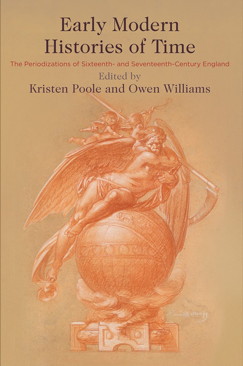
Poole, Kristen, and Owen Williams, eds. Early Modern Histories of Time: The Periodizations of Sixteenth- and Seventeenth-Century England. Philadelphia: University of Pennsylvania Press, 2019.

Early Modern Histories of Time, ed. Kristen Poole and Owen Williams

The University of Pennsylvania Press released this edited collection ten days ago. I’ve been reading through it since then in preparation to send off the final version of my second book (also to be published by Penn Press). I recognize that the book isn’t “for” me, someone who primarily studies medieval literature. Nonetheless, I think I’ve worked in and across these two fields and on this topic long enough to earn an opinion.

Early Modern Histories of Time should be seen as part of a periodization industry in English studies that began c. 2005 and is now on the downswing. All fifteen essays (except one, which could be summarized: “I am a very clever close reader”) have something to offer beyond the particular examples given. I’ll exercise the prerogative of a blog post and won’t mention all fifteen.

Naturally I paid special attention to the one medieval literature expert, James Simpson (“Trans-Reformation English Literary History”). In his characteristically clear and polemical prose, Simpson synthesizes one of the main planks of his research agenda, the analysis of literature, religion, and politics across the English Reformation. His critique of the resolutely synchronic frames of reference for medievalist and early modernist historicist scholarship, 1970-2000, is spot-on. I don’t agree with Simpson’s premise that religion and politics are more consequential for (English literary) history than other dimensions of human experience, but at least he feels the need to argue the point out loud. By prioritizing the same two domains that historically generated the medieval/modern break, Simpson leaves himself no choice but to accept the break on new terms. The inversion of the narrative of modernity, as opposed to its displacement or replacement, was both a feature and a limitation of Simpson’s Reform and Cultural Revolution. Here he concludes with an optimistically “synergetic” (100) vision of medievalist and early modernist collaboration.

The essay that most impressed me was the one by Mihoko Suzuki (“Did the English Seventeenth Century Really End at 1660? Subaltern Perspectives on the Continuing Impact of the English Civil Wars”). Opposing the division of the English seventeenth century at 1660, Suzuki weaves together comparative political history (English / Japanese); women’s studies / subaltern studies; ideology critique; and, again in a comparative mood, a takedown of “Renaissance.” Amazingly, or predictably, this is the volume’s only extended discussion of that all-consuming narrative category. Suzuki’s is an essay I will be glad to cite in my book, which ends c. 1650 but has no investment in halving the seventeenth century (or in renaissances).

Another standout essay is by Natasha Korda (“Much Ado about Ruffs: Laundry Time in the Feminist Counter-Archives”). I studied Shakespeare with Korda in college. Her essay identifies a dissenting form of periodization in the feminine labor behind Elizabethan ruffs. There was a (to me) surprising depth and breadth of evidence for this claim. The essay ends with a fantastic reading of the centrality of ruffs to Virginia Woolf’s literary imagination.

Ethan H. Shagan’s essay (“Periodization and the Secular”) is medievalist-friendly. Shagan argues that secularism is not the opposite of religion, as narratives of secularization maintain, but a development internal to the relationship between (Christian) religion and (Western) society. This argument neutralizes one of the most popular criteria for the dismissal of the medieval past, that it was an age of superstition, succeeded by an age of reason. Shagan’s ecclesiological history chimes with Simpson’s–as does an insightful postscript on Shakespeare as prophet of twenty-first-century “postsecularism” in the contribution by Julia Reinhard Lupton (“Periodic Shakespeare,” 210-12).

Despite what I interpret as good intentions, the collection has a problem of scope, of which the editors are aware. The book explores periodization concepts “indigenous” to early modernity, but structurally it takes early modernity for granted. This would be an issue in a book in any subfield; it’s particularly vexatious coming from early modernists, since “Renaissance” / “early modern” is the period of European history that habitually claims to have invented periodization. (The eighteenth century has a better claim, for it was then that periodization became standardized, totalized, and institutionalized, according to Davis.) The claim for a “birth of the past” in early modernity is a durable one, always made at the expense of a supposedly anachronistic Middle Ages.* While the editors and some of the contributors acknowledge what has been left out, most are content to imply that the Middle Ages had no “indigenous” periodizations, that the project of this volume is uniquely possible for post-1500 English literature and culture. But it isn’t.

Gordon Teskey (“The Period Concept and Seventeenth-Century Poetry”) gorgeously describes the experience of working in a period through the historically apt metaphor of the inner surface of a sphere. Yet Teskey betrays no sense that there might be anything wrong with being trapped inside a sphere. “We could not do research without periods. And of course we could not–at least until recently–organize a curriculum without periods” (150), he writes, repeating the most common defense of periodization, the defense from inevitability. But of course we could! Before the 1830s, we did (Underwood). There are too many moments in this volume in which the contributors treat periodization in the disciplinary present as a mere “mathematical convenience” before pivoting to the historical texts and topics that interest them. The result is a shortchanging of the ostensible payoff of this exercise. One gets the impression that early modernity possessed nuanced, multifarious, politically labile periodizations, while early modernists possess. . .the early modern, period. In this regard I’d contrast this book with Cole and Smith, a majority-medievalist effort that both explores the medieval period’s self-periodizations and challenges its retroactive construction as a period in the first place. An honorable exception is the essay by Heather Dubrow (“Space Travel: Spatiality and/or Temporality in the Study of Periodization”), which criticizes “early modern” both on historical grounds and “in terms of the professional domains we inhabit today” (258). Only Dubrow expresses the point that the intellectual content of literary periods depends on the social logic of disciplinary formation (cf. Underwood).

It’s axiomatic that any arbitrarily selected segment of history will both resemble the preceding centuries and resemble the subsequent ones. The choice of whether to bracket the sixteenth and seventeenth centuries with what came before or with what came after is just that, a motivated choice. The overview essay by Tim Harris (“Periodizing the Early Modern: The Historian’s View”) clarifies this point. The problem with “early modernity” in literary studies is that its arbitrariness has been lost to consciousness, submerged in the distribution of professional labor. Neither medievalists nor early modernists are obliged to think about the boundary line in the normal course of their professional duties, except when teaching a survey of British literature or (this happened in my grad program) when a “Medieval and Renaissance” colloquium splits up. The situation is not as drastic in history departments, in which period and area are dueling organizational principles. Historians can pick up and put down periods with greater equanimity. It’s telling that the other two contributors with expertise in the Middle Ages, apart from Simpson, are a historian (Euan Cameron, “How Early Modern Church Historians Defined Periods in History”) and an archaeologist (Kate Giles, “Time and Place in Shakespeare’s Stratford-upon-Avon”). The problem with literary periodizations, and “early modern” above all, is that they are sticky.

This book won’t unstick them, much as it yearns to. But probably no book could do that. All in all, Early Modern Histories of Time has some uncommonly good thinking about literature and temporality.


*Zachary Sayre Schiffman, author of The Birth of the Past (Baltimore: Johns Hopkins University Press, 2011), blurbed this book. There is a cottage industry in Renaissance studies of monographs dedicated to pursuing this same claim. Munro proves it’s possible to discuss early modern historicism without leaning on a cardboard replica of the Middle Ages. (Many medieval European authors were intensely interested in the alterity of the past! There were whole poems, narratives, sermons, and theological quandaries about it!)

further reading

Cole, Andrew, and D. Vance Smith, eds. The Legitimacy of the Middle Ages: On the Unwritten History of Theory. Durham, NC: Duke University Press, 2010.

Davis, Kathleen. Periodization and Sovereignty: How Ideas of Feudalism and Secularization Govern the Politics of Time. Philadelphia: University of Pennsylvania Press, 2008.

Munro, Lucy. Archaic Style in English Literature, 1590-1674. Cambridge: Cambridge University Press, 2013.

Simpson, James. Reform and Cultural Revolution. Oxford: Oxford University Press, 2002.

Underwood, Ted. Why Literary Periods Mattered: Historical Contrast and the Prestige of English Studies. Stanford: Stanford University Press, 2013.

on liking Chaucer

First, some background. I began reading medieval English poetry the summer after high school (a failed attempt at my parents’ copy of Chaucer). What attracted me initially was the linguistic challenge:

Whan that Aprille with his shoures soote
The droghte of March hath perced to the roote
. . .

I sensed that Middle English belonged to me as an English speaker, that no one else could claim an upper hand in it except by dint of the same sort of study I was putting in. This was even truer of Old English, the language of Beowulf. There are words in Old English whose meanings are simply unknown. More than dead liturgical languages like Latin or Sanskrit, Old English is a lost language. That appealed to me. At the end of college, I decided to become a medievalist.

This was my preprofessional formation. I linger over it because the issue of who the Middle Ages are for is politically fraught. There has rightly been a movement to decolonize medieval studies, still an overwhelmingly white field. It is Eurocentric by definition, since the sequence ancient-medieval-modern originated in European historiography.

In graduate school, I learned that medieval literature was related to the places in which it was made. Chaucer spoke for London and the royal court. Most other writing in English was “provincial,” a catch-all term and often pejorative. I studied this literature long before setting foot in England, so that my mental map of the country was drawn out of a reading of the literature. I was once challenged at a conference on my definition of “southern” for tenth-century England. My definition conflicted with modern UK regional nomenclature. On reflection, I was glad the issue came up. It’s an issue of different social trajectories in the academy. My own perspective made me receptive to weird, dislocational arguments like that of Nicholas Howe (a Yale PhD from the New York metro area, like me), who theorized that the capital city of early medieval England was Rome.

*

I teach Chaucer every other year to undergraduates, and I have a professional obligation to like him. It’s an obligation that’s taken some years to fulfill. I dutifully published an essay on him in graduate school in the Chaucer Review, connecting the Friar’s Tale to medieval forest bureaucracy—a topic that interested me more than Chaucer, at the time. The essay was intended to prove to potential employers that I could “do” Chaucer. One reader wrote that the historical dimension of the essay was stronger than the literary one. It was probably supposed to be an insult. But it was true.

I found Chaucer’s writing smug. I could feel the author winking at the reader through his characters. His stories were too comfortable being stories. The Canterbury Tales were poetic in form, but their style reminded me of modern novels and reminded me why I did not choose to study modern novels. Chaucer was so urban (at least to this rural reader), but his urbanness was deflected, almost never present on the surface of the work itself. You had to go to grad school to learn about it.

It has taken me years to place Chaucer to my satisfaction. My first book gave him only a cameo appearance. That book was more concerned with bridging the subfields of Old English and Middle English, which parted ways in the nineteenth century. In my second book, I have a trio of chapters that plugs Chaucer back into a literary context that makes sense to me. I realized what I really disliked was the gravitational pull he exerts on late medieval English studies. Instead of seeing Chaucer as (I think) he was, an initially insignificant sliver of his literary world, the field treats him as a benchmark for other writing in English. This remains the case whether he is read as prototypically English or, more recently, as a minor French or Italian writer. The field looks back on Chaucer through fifteenth-century goggles, for it was then that he became a benchmark. I teach Chaucer as an aberration, intentionally deflating students’ expectations about studying “the Father of English Poetry.”

My book puts Chaucer back in his place through the histories of English meters. Chaucer was a great innovator in this area. He invented the iambic pentameter. But Chaucer’s invention had a minimal impact prior to c. 1450. That’s a missed connection of half a century after the poet’s death. I wanted to write scholarship that recovered the weirdness of pentameter prior to that moment of mainstreaming.

Part of my reconciliation to Chaucer involved deeper study of his pre-CanterburyTales writing, the dream visions: the Romaunt of the RoseDeath of Blanche the Duchess,* House of Fame, Parliament of Fowls, and Legend of Good Women. Less commonly taught than the Canterbury Tales, these poems are less novelistic, more ‘medieval.’ The first three are in iambic tetrameter. They show us a Chaucer who has not yet had the pentameter idea.

The other missing piece fell into place when I read William Langland’s Piers Plowman. Langland provides vital context for reading Chaucer. You would almost think the two men belonged to different worlds. Their poems belong to different orders of reality.** Chaucer is a ubiquitous London bureaucrat, Langland a shadowy western cleric. But Langland lived in London, as well. His poem has a doubleness of place that corresponds to a certain flatness I detect in parts of Chaucer. Chaucer’s Canterbury pilgrimage is a pretext for stories; for Langland, being in transit is the main thing. The House of Fame, my favorite of Chaucer’s poems, is not coincidentally the work of Chaucer that shows most clearly (we think) the influence of Piers Plowman. Langland, the “provincial” author, provincializes Chaucer. Piers Plowman thematizes that which Chaucer can’t or won’t say about himself.

I’m writing this blog post to record the chain of events that, over time and through many discussions with my students, has generated my take on Chaucer. My book simply unspools this take as achieved knowledge, but perhaps there’s value or interest in the personal backstory.

It’s OK not to like the texts you study or teach. Sometimes there’s something to be learned, about the text or about yourself, from sitting with dislike.


*Known today under the title The Book of the Duchess. But see Ellis.
**Bourdieu’s field theory has been helping me sort out the relationship between social placement and literary style in my research into early English poetry. The term “social trajectory” is Bourdieu’s.

further reading

Bourdieu, Pierre, and Randal Johnson, ed. The Field of Cultural Production: Essays on Art and Literature. New York: Columbia University Press, 1993.

Ellis, Steve. “The Death of the Book of the Duchess.” Chaucer Review 29 (1995): 249-58.

Grady, Frank. “Chaucer Reading Langland: The House of Fame.” Studies in the Age of Chaucer 18 (1996): 3–23.